United Kingdom Student Visa: Requirements, Cost and Application Steps for 2026
Anyone aged 16 or over who wants to study a course longer than six months in the United Kingdom needs a Student visa. This route replaced the Tier 4 (General) student visa in October 2020, and it remains the primary path for international students attending UK universities and colleges. The sections below cover eligibility, cost, required documents, processing time, work rights, dependants, refusal risks and what comes after the visa expires, using figures current as of 2026.
What Is a United Kingdom Student Visa?
A United Kingdom student visa is an immigration permission that allows a person aged 16 or over to live in the UK for the duration of an approved course. UK Visas and Immigration (UKVI), the government body responsible for immigration decisions, issues this permission electronically as an eVisa rather than a physical document. Students younger than 16 who want to attend an independent school use the Child Student visa instead, covered later in this article.
Who Qualifies for a United Kingdom Student Visa?
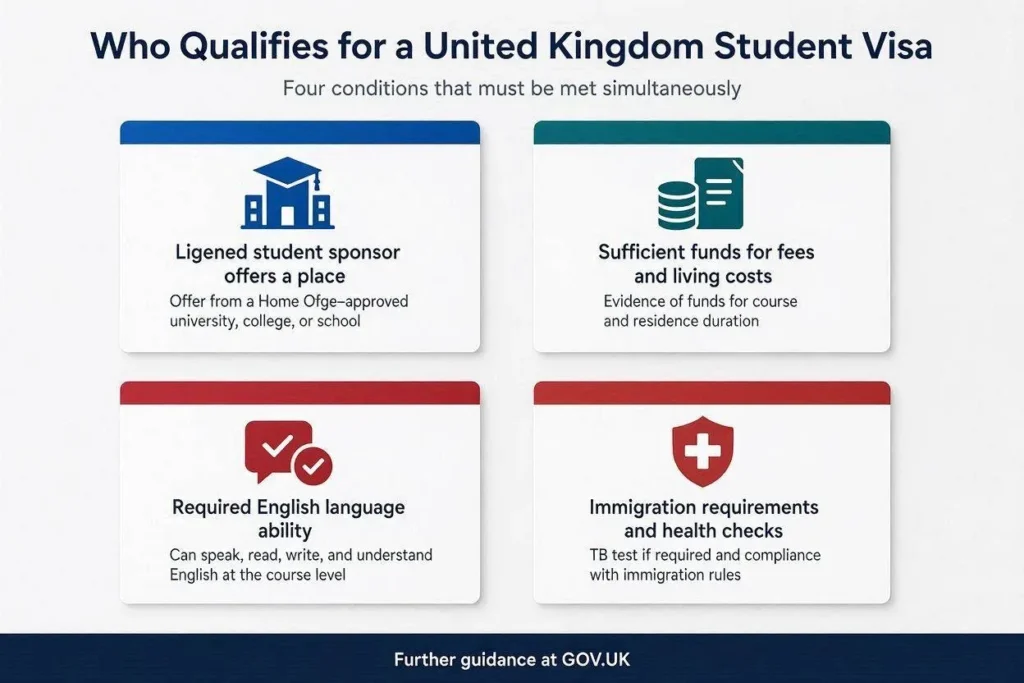
You qualify for a United Kingdom student visa if you meet four conditions at once. First, a licensed student sponsor — a UK university, college or school approved by the Home Office — has offered you a place on a course. Second, you have enough money to cover your course fees and living costs for the length of your stay. Third, you can demonstrate the ability to speak, read, write and understand English at the level your course requires. Fourth, if you are 16 or 17 years old, you provide written parental or guardian consent as part of your application.
Meeting these four conditions does not guarantee approval. A caseworker also assesses whether your application is genuine, checking your study history, financial documents and stated intentions for consistency.
How Much Does a United Kingdom Student Visa Cost?
A United Kingdom student visa costs £558 to apply for from outside the UK, and £558 to extend or switch to from inside the UK. That figure covers the visa application fee only. Most applicants also pay the Immigration Health Surcharge (IHS), which gives access to National Health Service (NHS) treatment during your stay. The IHS costs £776 per year of visa validity, or £388 for a stay of six months or less. A five-year Student visa therefore carries an IHS bill of roughly £3,880 on top of the £558 application fee, bringing the combined upfront government cost to around £4,438 (approximately $5,600 or €5,150 at mid-2026 exchange rates, though rates fluctuate).
Applicants who want a faster decision can pay for a priority service. Availability depends on your country of application, and UKVI confirms eligibility for this upgrade once you start your application rather than in advance.
What Documents Do You Need for a United Kingdom Student Visa?
Every applicant provides a valid passport or other travel document and a Confirmation of Acceptance for Studies (CAS), a reference number your sponsor issues once you accept an unconditional offer. Universities typically charge a small administrative fee, often around £25, to issue this document.
Beyond the passport and CAS, four additional documents apply depending on your circumstances:
- Bank statements or other proof of funds covering tuition and living costs
- Evidence of English language proficiency, in the format your sponsor specifies
- An Academic Technology Approval Scheme (ATAS) certificate, required for postgraduate research or study in sensitive STEM subjects — applicants from the European Union, the United States, Australia and several other exempt countries do not need this certificate
- A tuberculosis (TB) test certificate, required only for applicants from countries on the Home Office’s TB testing list
Collecting financial evidence takes the longest of these steps. Start gathering bank statements and sponsor letters at least two months before you plan to submit your application.
How Much Money Do You Need to Show?
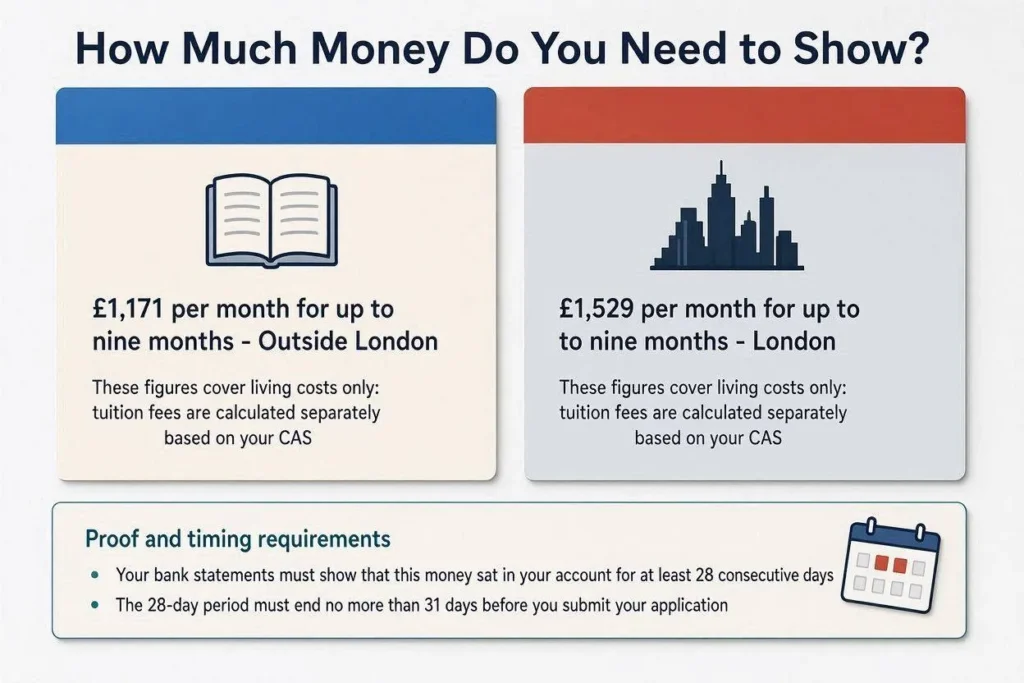
You need £1,529 per month for up to nine months if your course is in London, or £1,171 per month for up to nine months if your course is outside London. These figures cover living costs only; tuition fees are calculated separately based on your CAS.
Your bank statements must show that this money sat in your account for at least 28 consecutive days, with the 28-day period ending no more than 31 days before you submit your application. If a financial sponsor is covering your fees or living costs, that sponsor provides a signed letter of consent dated within twelve months of your application.
How Long Does a United Kingdom Student Visa Take to Process?
Most United Kingdom student visa applications receive a decision within three weeks if you apply from outside the UK, or within eight weeks if you apply from inside the UK. Processing times vary by visa application center and by season — decisions often take longer in August and September, when application volume peaks ahead of the academic year.
When Can You Apply and Travel to the UK?
You can submit your application up to six months before your course starts if you apply from outside the UK, or up to three months before your course starts if you apply from inside the UK. Once your visa is granted, you can travel to the UK up to one month before your course begins if your course lasts longer than six months, or up to one week before if it lasts six months or less. Traveling earlier than the date printed on your visa is not permitted, regardless of when your course actually starts.
How Long Can You Stay on a United Kingdom Student Visa?
Visa length depends on your course level. You can stay in the UK for up to five years if you are 18 or over and studying at degree level, or up to two years if your course is below degree level. Students who need to continue studying beyond this period can extend their visa or switch to a new course, provided the new course meets the academic progression requirement set by the Home Office.
Can You Work on a United Kingdom Student Visa?
Yes. You can work up to 20 hours per week during term time if you are enrolled in a full-time course at degree level or above, and full-time during official vacation periods. Restrictions apply regardless of your course level: you cannot be self-employed, work as a professional sportsperson or sports coach, or claim public funds such as benefits or a state pension. Work placements that form a formal part of your course, common on business and management degrees, follow separate rules set by your specific course structure rather than the standard 20-hour limit.
Can You Bring Dependants on a United Kingdom Student Visa?
No, most students cannot bring dependants on a United Kingdom student visa. Eligibility is now restricted to two groups: students on a government-sponsored course lasting longer than six months, and full-time students on a postgraduate research-level course at RQF Level 7 or above — meaning a PhD, doctorate, or research-based higher degree — lasting nine months or longer. A small number of fully funded government scholarships also qualify, provided the scholarship is issued by a central government department and covers all fees and living costs. Most taught master’s degree students do not meet these criteria and cannot bring a partner or children during their studies.
What Is the eVisa and How Do You Access It?
Since 31 December 2024, physical Biometric Residence Permits (BRPs) no longer serve as valid proof of immigration status. Every Student visa holder now needs a UKVI account to access an eVisa, a digital record replacing the physical card. Set up your account using the travel document you plan to use to enter the UK, then link that document before you travel. Border officials and employers may ask you to prove your immigration status through this digital record rather than a physical document, so set up your account as soon as your visa is granted rather than waiting until you arrive.
Common Reasons United Kingdom Student Visa Applications Get Refused
Four issues account for most refusals. Financial evidence that falls short of the 28-day holding period, or that shows funds dipping below the required threshold at any point during that window, triggers an automatic refusal on financial grounds. Inconsistencies between your CAS details and your application form — a mismatched course start date or an incorrect sponsor license number — raise credibility questions even when the discrepancy is a clerical error. A poor performance in a credibility interview, where caseworkers ask about your study plans and reasons for choosing your course, can result in refusal even when your paperwork is otherwise complete. Missing a required TB test certificate for applicants from a listed country causes an incomplete-application refusal rather than a substantive one, but it still costs you the application fee and months of delay.
Applicants refused on financial or documentary grounds can usually reapply once the underlying issue is fixed, though a fresh application means a new fee and a new processing clock.
What Happens After Your United Kingdom Student Visa Expires?
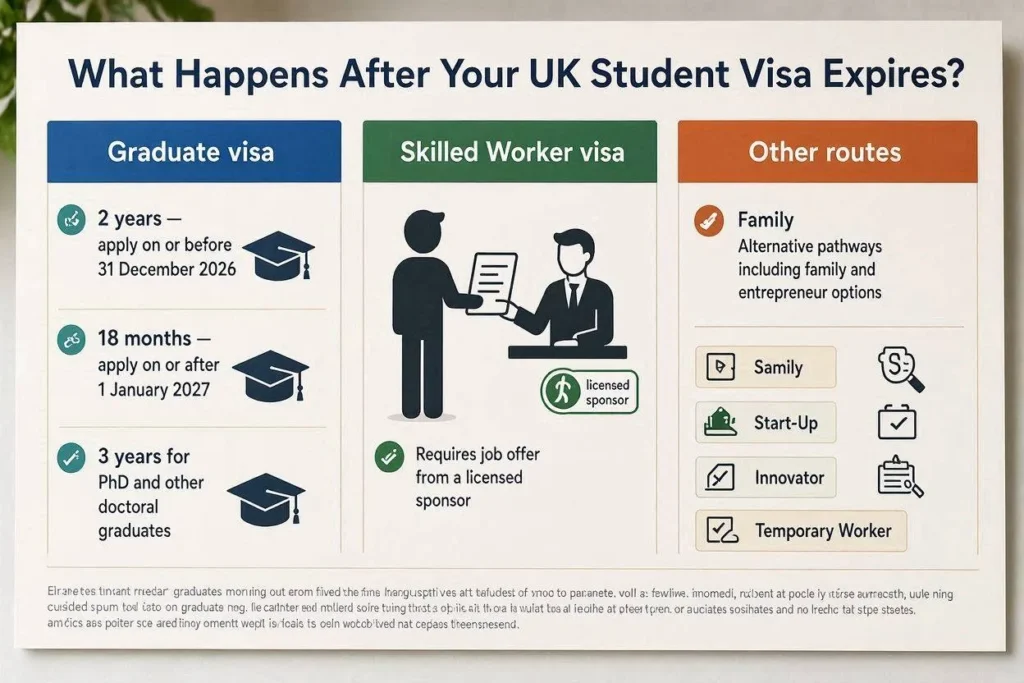
Three main routes exist for graduates who want to stay in the UK. The Graduate visa allows two years of post-study work if you apply on or before 31 December 2026, dropping to 18 months for applications submitted on or after 1 January 2027; PhD and other doctoral graduates receive three years regardless of application date. The Skilled Worker visa suits graduates who secure a job offer from a licensed sponsor, and applicants under 26 qualify as “new entrants,” meaning a lower salary threshold applies. A Spouse visa is available to graduates who marry a British citizen or a person with indefinite leave to remain (ILR), granting two and a half years of residence without work restrictions.
No direct route from a Student visa to indefinite leave to remain exists. Reaching ILR normally requires several years on a qualifying work route, such as the Skilled Worker visa, after your studies end.
United Kingdom Student Visa Guidance by Region
Documentation norms shift by country of application. Applicants from Nigeria and several Gulf states more frequently rely on financial sponsor letters rather than personal bank statements, and caseworkers scrutinize the sponsor relationship and source of funds closely in these cases. Applicants from India and China face some of the highest financial-document refusal rates in the system, often tied to bank statements that do not clearly show the required 28-day balance in the correct currency format. Gulf-based applicants sometimes need additional verification of employer-sponsored funding given the prevalence of employer-paid education benefits in the region.
European Union students lost automatic visa-free study access after Brexit and now follow the same Student visa route as applicants from any other country, with one exception: EU, Icelandic, Liechtenstein, Norwegian and Swiss nationals can complete the identity verification stage of their application using a smartphone app rather than attending a visa application center in person. EU students also pay the same “overseas” tuition fee rate as other international applicants at most UK universities, a change from the “home” fee status EU students held before 2021, and this shift affects loan eligibility and overall budget planning far more than the visa process itself.
Other UK Study Visa Routes
Three additional visa types cover study situations outside the standard Student visa. The Child Student visa applies to students aged 4 to 17 attending an independent school in the UK. The Short-term Study visa suits students taking an English language course lasting between six and eleven months. The Standard Visitor route covers courses of six months or less at an accredited institution, and in some cases recreational courses of up to 30 days require no visa at all for eligible nationalities.
Choosing the correct route before you apply prevents delays: a Short-term Study applicant who mistakenly applies through the Student route, for example, faces rejection for applying to the wrong category rather than a substantive refusal.
Conclusion
A United Kingdom student visa application succeeds or fails on four factors: a valid Confirmation of Acceptance for Studies (CAS) from a licensed sponsor, financial evidence that clears the 28-day threshold at the correct amount, English proficiency proof in the format your sponsor requires, and a consistent, credible story across every document you submit. Budget £558 for the application fee and £776 per year for the Immigration Health Surcharge (IHS), then add tuition and the London or non-London maintenance figure on top. Apply within the six-month or three-month window that matches your location, set up your UKVI account the moment your visa is granted, and check the regional documentation notes if you are applying from India, Nigeria, China or a Gulf state. Students who prepare financial evidence early and match every detail across their CAS, bank statements and application form avoid the refusal triggers that catch thousands of applicants each year.
FAQs

Michael Reynolds
Michael Reynolds leads ImmigrationWin’s immigration, visa, and global mobility content division. He specializes in researching immigration policies, visa requirements, application processes, and international relocation pathways for individuals, families, students, and professionals. With extensive experience analyzing immigration regulations and official government guidance, Michael brings a research-driven approach to complex immigration topics and changing visa policies. He is the primary author of ImmigrationWin’s visa guides, immigration resources, and country-specific content, helping readers better understand their options and make informed decisions about their international journey.
Related Posts