France Student Visa 2026: Complete Step-by-Step Guide for International Students
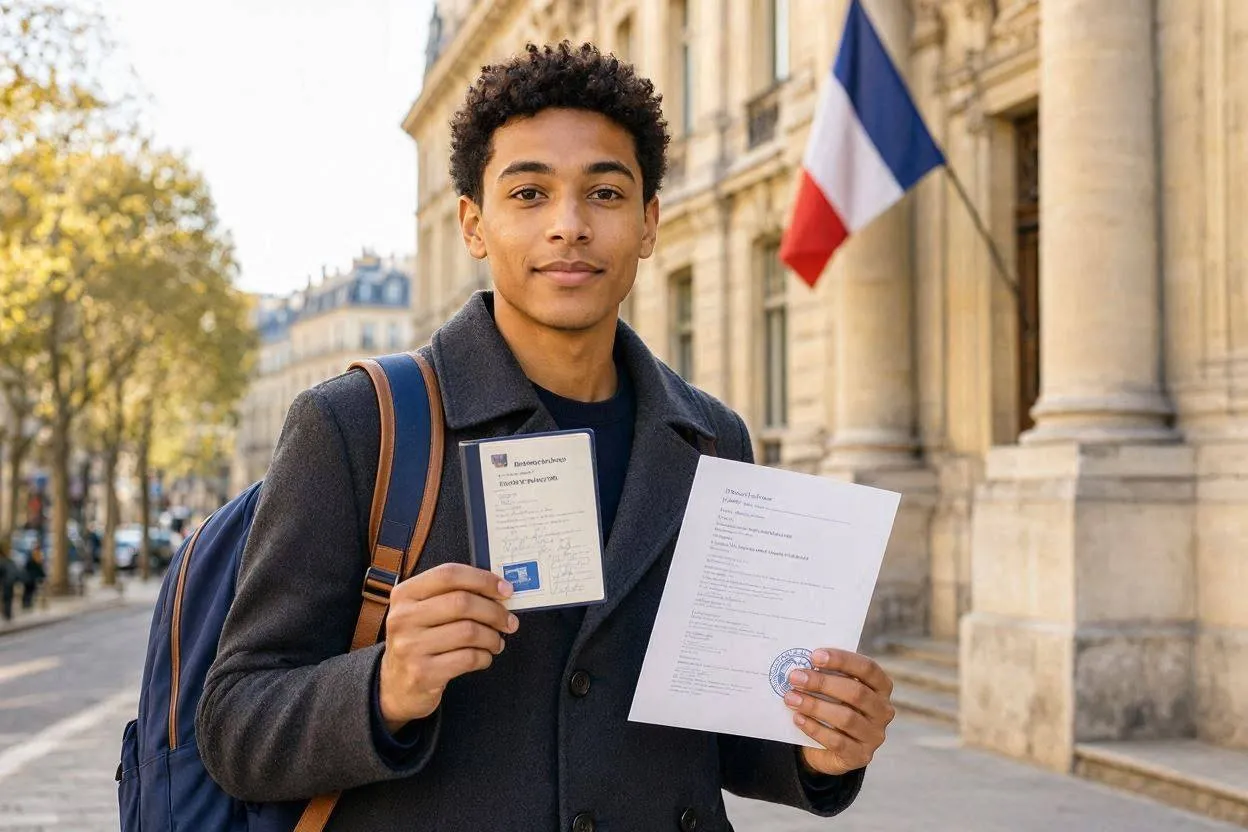
A France student visa lets non-EU nationals live in France for the length of an academic program lasting more than 90 days, and the main version you will apply for is the long-stay student visa, known as the VLS-TS (visa de long séjour valant titre de séjour). This single document works as both entry visa and residence permit for your first year, which removes the need for a separate prefecture appointment before you land.
Whether your acceptance letter comes from a public university in Lyon, a business school in Paris, or a language center in Strasbourg, the legal pathway stays the same. What changes by nationality and region — a real gap in most guides written only for a US audience — is whether you complete the Études en France procedure first, which consulate handles your file, and how the fee structure applies to your country.
This guide walks through every stage of the France student visa application for 2026, with separate notes for applicants coming from the United States, the United Kingdom, the European Union, Canada, the Middle East, and Asia.
Do You Need a Student Visa for France?
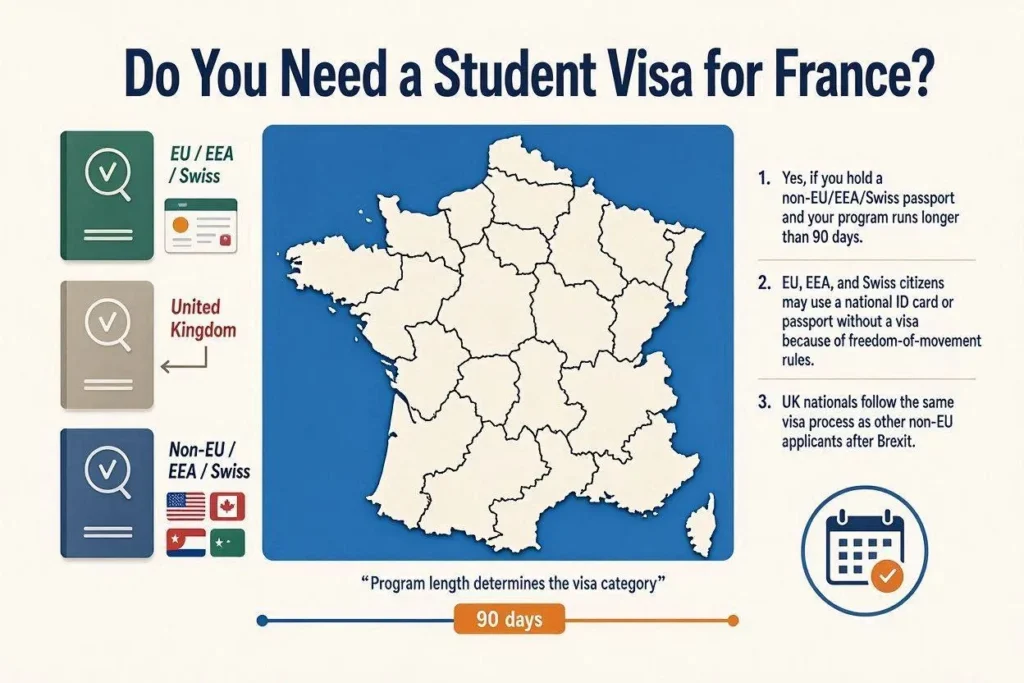
Yes, if you hold a non-EU/EEA/Swiss passport and your program runs longer than 90 days. EU, EEA, and Swiss citizens can study and reside in France without a visa, using only a national ID card or passport, because of freedom-of-movement rules within the bloc. UK nationals lost this exemption after Brexit and now follow the same visa process as US, Canadian, Middle Eastern, and Asian applicants.
Program length determines the visa category, not nationality alone:
- 90 days or fewer: a short-stay Schengen visa covers language courses, summer schools, and short exchange programs. This visa carries no work rights and cannot convert into a long-stay visa without leaving France.
- More than 90 days: the VLS-TS applies, covering a full academic year and doubling as your residence permit.
- 4 to 6 months: a VLST (visa de long séjour temporaire) fits mid-length exchange semesters. It skips OFII validation but cannot be renewed from inside France.
- Entrance exams or admission interviews: the étudiant-concours visa allows a stay of up to 90 days. If the exam results in admission, you can convert this visa into a full VLS-TS without leaving the country.
The Études en France (EEF) Procedure
Études en France (EEF) is the online pre-consular platform that most non-EU applicants must complete before submitting a visa application, and it exists in over 280 Campus France spaces across more than 130 countries. Whether EEF applies to you, and how much your visa costs, depends on which list your country sits on.
Applicants from EEF-listed countries pay a reduced visa fee of €50 and benefit from a smoother document review, because Campus France has already checked their academic transcripts during the platform registration. Applicants from non-EEF countries pay €99 and submit academic records directly at the consulate instead.
The EEF steps run as follows:
- Create an account on the Études en France portal and select your programs.
- Upload academic transcripts, diplomas, and language certificates.
- Submit the application and pay the Campus France processing fee, where applicable.
- Attend an academic interview, conducted online or in person, evaluating your language level and motivation.
- Receive the “Accord de la commission,” the formal Campus France approval that unlocks the visa application step.
Students who already hold an unconditional offer sometimes qualify for an “I am accepted” fast-track inside the same platform, skipping the interview stage.
Step-by-Step: How to Apply for a France Student Visa
The full sequence runs through eight steps, from university acceptance to visa collection.
- Secure admission. Obtain a written acceptance letter (attestation d’inscription or attestation de pré-inscription) from a recognized French institution, showing the exact program dates — these dates set the boundaries of your visa validity.
- Complete the EEF procedure, if your country requires it, and wait for Campus France approval.
- Start the France-Visas wizard at france-visas.gouv.fr. The tool builds a personalized document checklist and generates your application form based on nationality, residence, and program type.
- Book your appointment at the consulate or an outsourced visa center — VFS Global, TLScontact, or Capago, depending on your country. Book between three months and two weeks before your travel date; during the May-to-July peak, VFS Global wait times have stretched to 60 days in some locations, so early booking protects your start date.
- Upload supporting documents digitally where the online submission feature is available, checking that every scan is legible before you validate the file.
- Attend the biometric appointment. Applicants aged 12 and over provide a photo and ten fingerprints in person, unless their biometrics were already captured within the previous 59 months.
- Pay the visa fee and service charge, then wait for processing.
- Collect your passport once notified, and check the visa sticker for the correct entry date, validity period, and the “VLS-TS” annotation before you travel.
Document Checklist
Consulates request a broadly consistent set of documents, though local requirements can add extra items:
- Valid passport issued within the last 10 years, with at least two blank pages, valid for three months beyond your visa end date
- Completed and signed France-Visas application form
- Recent passport-style photograph meeting ICAO specifications
- Letter of admission or attestation of enrollment from your French institution
- EEF confirmation, for applicants from EEF-listed countries
- Proof of financial resources covering at least €615 per month for your full stay
- Proof of accommodation for your first three months in France
- CVEC payment receipt (Contribution Vie Étudiante et de Campus), which signals a finalized enrollment
- Visa appointment confirmation and fee payment receipt
Missing paperwork remains the single most common reason for delays, so consulates recommend organizing every document in the exact order their checklist specifies.
Financial Proof: The €615/Month Rule
France requires proof of at least €615 per month, which totals approximately €7,380 for a full academic year, and this figure has not changed for 2026. Consulates accept several forms of evidence:
- Personal bank statements from the past three to six months showing consistent balances
- A blocked account through providers such as Studely or Fintiba, which releases funds monthly and speeds up processing in many cases
- A sponsor guarantee (attestation de prise en charge) from a financial guarantor residing in France, accompanied by that guarantor’s tax returns and bank statements
Showing more than the minimum strengthens an application rather than weakening it. For programs based in Paris, a realistic monthly budget runs closer to €1,000 to €1,200 once rent, food, and transport are factored in, and consulates reviewing Paris-based applications tend to view stronger financial buffers favorably.
Fees Breakdown for 2026
| Fee | Amount | When paid |
| Visa fee (EEF countries) | €50 | At the consulate or visa center |
| Visa fee (non-EEF countries) | €99 | At the consulate or visa center |
| Service provider fee (VFS Global, TLScontact, Capago) | Capped at €40 | At appointment booking |
| CVEC (student life tax) | €105 | Before or during enrollment |
| OFII validation stamp | €60 | Online via ANEF, after arrival |
Fee exemptions apply to French government scholarship holders, recipients of select foreign-government or foundation scholarships, and foreign language assistants, among a few other categories. Public university tuition sits separately from these visa costs, currently around €2,770 per year for non-EU undergraduates and €3,770 for Master’s students, though partner scholarships and grandes écoles exemptions can reduce this for eligible applicants.
Processing Time
Standard processing runs 15 days, extendable up to 45 days for applications needing extra review. In practice, peak season between May and August pushes real turnaround closer to four to six weeks at many consulates, driven by appointment backlogs rather than the legal processing window itself. Applying four to five months before your intended start date, and no later than June for a September intake, keeps you clear of these bottlenecks.
Regional Notes for International Applicants
Your home region changes which office handles your file and which procedure applies, even though the underlying visa rules stay the same across nationalities.
- United States and Canada: Apply through Campus France USA or Campus France Canada, then book appointments through VFS Global or TLScontact in your consular district. Both countries sit on the EEF list for most programs, so the €50 fee and streamlined academic review apply.
- United Kingdom: UK nationals now follow the standard non-EU visa process, applying through the France-Visas wizard and a UK-based visa center, since freedom-of-movement rules ended after Brexit.
- European Union and EEA: Citizens of EU and EEA member states, along with Switzerland, need no student visa at all and can study in France using only a valid national ID or passport.
- Middle East: Applicants from Gulf and wider Middle Eastern countries generally use Campus France offices where available; countries without an EEF procedure submit academic records directly to the consulate and pay the €99 fee.
- Asia: Countries with large Campus France networks, including India, tend to run the EEF track with online interviews, while smaller markets without a Campus France office apply directly through France-Visas.
Non-EEF applicants across every region should budget extra time for direct academic verification at the consulate, since this step happens later in the process than it does for EEF countries.
Health Insurance and Housing Documentation
French universities require proof of health coverage before finalizing enrollment, and most non-EU students join the national student health scheme (Sécurité Sociale Étudiante) automatically once registered, through the Ameli platform. EU and EEA students instead use the European Health Insurance Card (EHIC) for coverage during their stay. Private supplementary insurance (mutuelle) remains optional but common, since the national scheme reimburses only a portion of medical costs. Some consulates additionally require proof of a private international policy covering the period between your visa issuance and your Sécurité Sociale registration, so check your specific consulate’s checklist rather than assuming the national scheme alone satisfies every document requirement.
Accommodation evidence accepted by consulates falls into four categories, and providing the wrong type is a common source of delay:
- University or CROUS housing: an official confirmation letter from the residence, showing your name and the assigned room’s address
- Private rental agreement: a signed lease covering at least the first three months of your stay
- Host family or friend: an attestation d’hébergement (hosting letter) from the host, along with their government ID and a utility bill less than three months old
- Temporary accommodation: a hotel or short-term booking confirmation, acceptable only as a bridge while you finalize longer-term housing
Consulates cross-check the dates on your accommodation document against your admission letter, so gaps between the two are worth resolving before your appointment.
Choosing the Right Consulate and Appointment Slot
Your visa file goes to the French consulate or embassy with jurisdiction over your place of legal residence, not necessarily your nationality. Students living in a country other than their passport country — a common situation for Gulf-based Asian professionals sending a dependent to study, or US permanent residents holding a different nationality — should confirm jurisdiction on France-Visas before booking, since applying at the wrong consulate causes delays that early planning avoids entirely.
Appointment availability varies sharply by city and season. Consulates in major hubs — New York, Los Angeles, London, Toronto, Dubai, New Delhi, and Beijing — see the heaviest volume between May and August, when appointment slots at outsourced centers can book out weeks in advance. Booking the moment your Campus France approval or admission letter arrives, rather than waiting for every document to be finalized, secures your slot while you continue preparing the rest of your dossier.
Visa for Minors: “Mineur Scolarisé”
Students under 18 enrolling in a French school follow a distinct visa track, the “mineur scolarisé” visa. Requirements differ meaningfully from the adult VLS-TS process: parents or legal guardians typically provide notarized consent, proof of guardianship arrangements in France, and confirmation of enrollment at a recognized school, and financial proof requirements are assessed against the guardian’s resources rather than the minor’s own.
After You Arrive: OFII Validation and Housing
Your VLS-TS is not fully valid as a residence permit until you complete online validation through the ANEF portal within three months of arrival, paying a €60 tax stamp during that process. Missing this three-month window can make your stay irregular, which risks deportation or future visa bans, so treat this step as mandatory rather than optional paperwork.
Beyond validation, most students register for CAF (Caisses d’Allocations Familiales), the French housing subsidy that refunds approximately €100 to €200 per month toward rent for eligible international students. Applications open once you have a French address and a validated visa.
Working While You Study
International students on a VLS-TS can work up to 964 hours per year, equal to roughly 20 hours per week, without needing a separate work permit. Algerian nationals fall under a different bilateral agreement and are limited to 50% of full-time hours rather than the standard 60%. Your visa or carte de séjour is sufficient proof of work eligibility, though employers still verify status and must declare your employment to the local prefecture.
France’s minimum wage (SMIC, Salaire Minimum Interprofessionnel de Croissance) stands at €11.88 gross per hour as of January 2026. A student working 15 hours weekly across 10 months earns roughly €7,128 gross, enough to cover a meaningful share of living costs outside Paris, though part-time work should supplement your financial proof rather than replace it.
Renewing Your Student Status
Your VLS-TS covers one academic year. Before it expires, apply at your local prefecture for a carte de séjour pluriannuelle étudiant, a multi-year residence permit that can cover up to four additional years for longer programs. Submit this renewal application two to four months before your current visa expires, since prefecture appointment slots fill up well in advance in university cities.
Family members cannot join you automatically. Family reunification only becomes available after you have held legal student residency for at least 18 months, or if you qualify separately for the Talent Passport scheme.
Scholarships That Affect Your Visa File
Several scholarship categories change your financial-proof burden and, in some cases, your visa fee entirely. Eiffel Excellence scholarship recipients, French government scholarship holders, and students funded by select foreign-government or foundation scholarships typically submit an award letter in place of standard bank statements, and some of these categories qualify for a full visa fee waiver. Foreign language assistants and readers working in France under bilateral teaching programs fall under a related exemption. If your funding comes from your home university, a bilateral exchange agreement, or an employer, ask your Campus France advisor or the consulate directly whether that funding letter can substitute for personal bank statements, since rules on acceptable substitute documents vary by consulate and change from one intake to the next.
Common Mistakes to Avoid
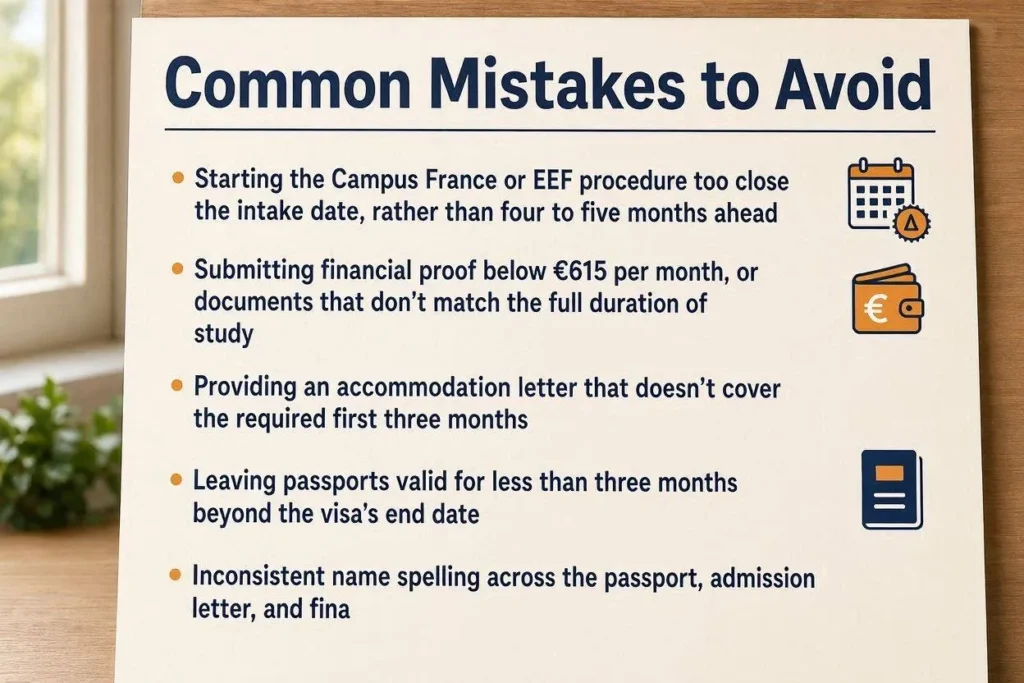
- Starting the Campus France or EEF procedure too close to the intake date, rather than four to five months ahead
- Submitting financial proof below €615 per month, or documents that don’t match the full duration of study
- Providing an accommodation letter that doesn’t cover the required first three months
- Leaving passports valid for less than three months beyond the visa’s end date
- Inconsistent name spelling across the passport, admission letter, and financial documents
- Forgetting to validate the VLS-TS through ANEF within three months of arrival
Visa Refusal and Appeal (Recours)
A refused application is not final. You can request the specific refusal reason in writing from the consulate, then file a “recours gracieux” (administrative appeal) directly with the consulate, or a “recours hiérarchique” with the Commission de Recours contre les Décisions de Refus de Visa in Nantes, generally within two months of the refusal notice. Strengthening weak points identified in the refusal — commonly financial proof or unclear admission documentation — before refiling improves outcomes more than resubmitting an unchanged file.
Conclusion
A France student visa comes down to five fixed elements: admission, the EEF procedure where your country requires it, financial proof of €615 per month, a complete document file, and validation through ANEF after arrival. Every mistake covered in this guide traces back to one of those five points arriving late, incomplete, or inconsistent with another document in the file. Applicants from the United States, the United Kingdom, Canada, the Middle East, and Asia follow the same core sequence, with only the consulate, the EEF requirement, and the fee tier changing by country. Starting the process four to five months before your intake, keeping your paperwork consistent across every document, and booking your appointment as soon as your admission letter arrives puts you ahead of the delays that catch most first-time applicants.
FAQs

Michael Reynolds
Michael Reynolds leads ImmigrationWin’s immigration, visa, and global mobility content division. He specializes in researching immigration policies, visa requirements, application processes, and international relocation pathways for individuals, families, students, and professionals. With extensive experience analyzing immigration regulations and official government guidance, Michael brings a research-driven approach to complex immigration topics and changing visa policies. He is the primary author of ImmigrationWin’s visa guides, immigration resources, and country-specific content, helping readers better understand their options and make informed decisions about their international journey.
Related Posts