Norway Student Visa 2026: Requirements, Costs & How to Apply
Students from outside the European Union (EU) and European Economic Area (EEA) must apply for a Norway student visa — officially called a residence permit for studies or study permit — before starting any course longer than 90 days. The application costs NOK 5,400 (about US$568 / £445 / €480), and you must prove access to NOK 170,368 (about US$18,000) for one academic year. Applications submitted to the Norwegian Directorate of Immigration (UDI) before 1 July 2026 receive a decision before the autumn semester begins in mid-August.
This guide covers every requirement for 2026, the exact documents you need, the seven application steps, common rejection reasons, and what happens after you land in Oslo, Bergen, or Trondheim. All figures come directly from UDI and the Norwegian Directorate for Higher Education and Skills (HK-dir).
What Is the Norway Student Visa?
The Norway student visa is a residence permit that allows non-EU/EEA citizens to live in Norway and study full-time at an accredited institution for more than three months. Norway issues no separate “visa” document for students; the study permit itself grants entry and residence. Many applicants search for “student visa,” while UDI uses “study permit” — both terms describe the same permit.
The permit covers six education types: universities and university colleges, vocational schools, upper secondary schools, folk high schools, religion-based schools (bible schools), and additional education for skilled workers seeking Norwegian recognition of their qualifications. University summer schools require no permit at all.
A granted study permit automatically includes the right to work 20 hours per week during the semester and full-time during holidays.
Who Needs a Norway Student Visa in 2026?
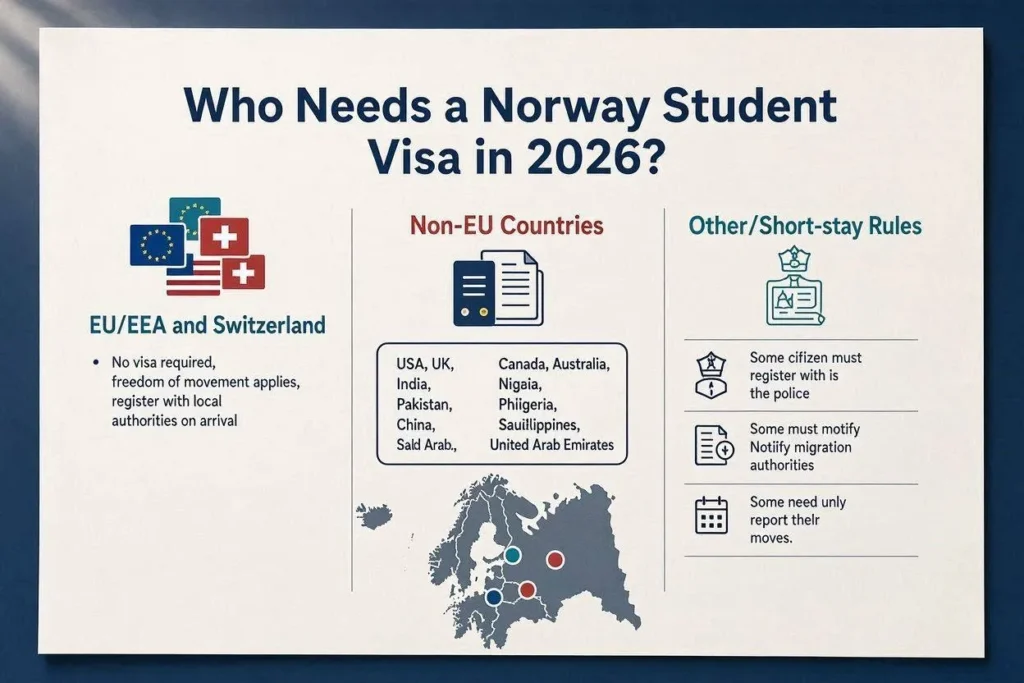
Your citizenship determines whether you apply for a study permit, register with the police, or simply report your move. Norway applies three different rule sets.
Students from the USA, UK, Canada, Australia, Asia, and the Middle East
Citizens of countries outside the EU/EEA and Switzerland — including the United States, United Kingdom, Canada, Australia, India, Pakistan, China, Nigeria, the Philippines, Saudi Arabia, and the United Arab Emirates — must apply for a study permit for any course longer than three months. British citizens lost their EU exemption after Brexit, so UK students now follow the same process as American or Indian applicants.
Applicants from countries with a visa requirement for entering Norway need an entry visa even for courses shorter than three months.
Students from the EU/EEA and Switzerland
Citizens of EU/EEA countries and Switzerland need no study permit. These students, for example German, French, and Dutch nationals, can stay 90 days without any formality and must register with the local Norwegian police within three months of arrival for longer stays. Registration requires a passport, an admission confirmation, health insurance or a European Health Insurance Card (EHIC), and a personal declaration of sufficient funds.
Students from Nordic countries
Citizens of Denmark, Sweden, Finland, and Iceland face no visa requirement and no police registration. Nordic students staying longer than six months report their move to a Norwegian tax office (Skatteetaten) for an identity check.
Norway Student Visa Requirements for 2026
UDI approves a study permit when the applicant proves four things: full-time admission, sufficient money, a place to live, and a likelihood of returning home after graduation. Each requirement has a precise standard.
Financial requirement: NOK 170,368 per year
You must document access to NOK 15,488 per month or NOK 170,368 per year (about US$18,000 / £13,300 / €14,700) for the 2026–2027 academic year. Single-semester students document NOK 77,440 for the autumn semester or NOK 92,928 for the spring semester.
Accepted sources include student loans, grants, personal savings, and income from a confirmed part-time job offer in Norway. The money must sit in a Norwegian bank account or in a deposit account operated by your educational institution. Foreigners without a Norwegian national identity number cannot open a Norwegian bank account, so most first-time applicants transfer the funds to their university’s deposit account — contact the international office of your institution, for example the University of Oslo or the Norwegian University of Science and Technology (NTNU), to arrange the transfer.
Students who pay tuition must show extra funds covering the fees, or documentation that the 2026–2027 tuition has already been paid. Requirements differ by school type: folk high school applicants document NOK 130,745 for the 2026/2027 school year including tuition, while bible school applicants document NOK 154,880 per year for living costs.
Admission to a NOKUT-accredited institution
Your place of study must appear on the accreditation list of the Norwegian Agency for Quality Assurance in Education (NOKUT). Admission must be for full-time study — Norway grants no study permits for part-time programmes, and vocational-school permits exclude online programmes entirely.
Admission itself depends on the Higher Education Entrance Qualification (GSU). The GSU list states country-specific requirements; Indian applicants, for example, need Standard XII plus one year of university education, while a US high school diploma requires additional Advanced Placement (AP) credits or college coursework. Check the GSU list before applying, because a study permit application collapses without valid admission.
Accommodation in Norway

You must document somewhere to live, for example a student housing contract from a student welfare organisation (Samskipnad), a private tenancy agreement, or a letter from a household hosting you. Samskipnad housing costs less than the open rental market in Oslo and Bergen, so apply for student housing as soon as your admission letter arrives.
Intent to return home
Circumstances in your home country must indicate that you can return after completing your studies. UDI assesses your ties — family, property, career prospects, and previous travel history. Weak return intent is the least understood requirement and one of the most common rejection grounds, particularly for applicants from countries with high emigration rates.
Norway Student Visa Document Checklist
Prepare nine documents before starting your application. Missing paperwork is the fastest route to processing delays.
- Passport valid for the entire study period
- Two recent passport-size photos with a white background
- Admission letter stating your name, study programme, and programme length
- Proof of funds: bank confirmation showing NOK 170,368 in a Norwegian account or institution deposit account
- Tuition payment receipt or exemption confirmation from your institution
- Housing documentation: tenancy agreement, student housing contract, or host letter
- Health insurance proof covering your stay (non-EU applicants)
- Completed and signed UDI document checklist for your nationality
- Receipt for the NOK 5,400 application fee
Applicants for additional education permits attach recognition-authority confirmation, and health personnel, for example nurses and doctors, attach authorisation correspondence from the Norwegian Directorate of Health.
How to Apply for a Norway Student Visa: 7 Steps
The application runs online through UDI’s Application Portal Norway, then finishes in person at an embassy or visa centre. Follow the sequence below.
Step 1 — Secure admission. Apply to a NOKUT-accredited institution and receive your admission letter. Most Norwegian universities close international admissions between December and March for the following autumn.
Step 2 — Transfer your funds. Move NOK 170,368 into your institution’s deposit account and request a confirmation letter. Bank transfers from South Asia and the Middle East can take 5–10 business days, so start early.
Step 3 — Complete the online application. Register on the UDI website, fill in the study permit application, upload documents, and pay the NOK 5,400 fee by card.
Step 4 — Book your in-person appointment. Attend a Norwegian embassy, consulate, or an outsourced visa application centre run by VFS Global. Applicants in India visit VFS Global centres in cities such as New Delhi, Mumbai, and Chennai; applicants in Pakistan use the centre in Islamabad; applicants in the USA attend the Norwegian embassy in Washington, D.C., or a consulate general in New York, Houston, or San Francisco.
Step 5 — Submit biometrics and originals. At the appointment, officials take your fingerprints and photograph and collect your original documents. The embassy holds your passport during processing — request its return in advance if you must travel before the decision.
Step 6 — Wait for the UDI decision. Track your case through the “My Page” login on udi.no. UDI may request extra documents; respond within the stated deadline or the application closes.
Step 7 — Travel and register. After approval, enter Norway and report to the local police station within 7 days to order your residence card.
Norway Student Visa Cost in 2026
Budget NOK 5,400 for the application fee alone, and roughly NOK 190,000–260,000 (US$20,000–27,500) for your first year in total. No competitor to your bank account is bigger than underestimating these totals.
| Cost item | Amount (NOK) | Approx. USD | Approx. GBP | Notes |
| Application fee | 5,400 | $568 | £445 | Paid online, non-refundable |
| Financial proof (living costs) | 170,368/year | $18,000 | £13,300 | Must be documented, then spent on living |
| Tuition fees (non-EU/EEA) | 80,000–500,000/year | $8,400–52,600 | £6,250–39,000 | Varies by institution and programme; EU/EEA students exempt at public institutions |
| Semester fee (Samskipnad) | ~1,000/semester | ~$105 | ~£78 | Mandatory student welfare fee |
| Health insurance | 3,000–8,000/year | $315–840 | £235–625 | Private policy for non-EU applicants |
| Residence card | 0 | $0 | £0 | Issued free by police |
Exchange students, doctoral candidates, and participants in schemes such as Erasmus Mundus, Fulbright, NORPART, NORHED, and Students at Risk (StAR) normally pay no tuition at public institutions.
Processing Time and the 1 July 2026 Deadline
Applications submitted before 1 July 2026 receive a decision before studies begin in autumn 2026, which usually means before mid-August. UDI publishes this guarantee for the autumn intake each year.
Processing after the deadline varies by nationality, season, and case complexity, and typically runs 1–3 months. Three factors extend waiting times: incomplete documents, funds parked in a non-Norwegian account, and peak-season volume between May and August. Applicants from countries requiring extra verification, for example applicants submitting through VFS Global centres in South Asia, face the longest queues, so submitting in April or May beats submitting in June.
Students normally cannot enter Norway while the application is pending, and part-time work — including remote work for an employer abroad — stays prohibited until UDI grants the permit.
What Happens After Approval: Police Registration, Residence Card, and Bank Account
Report to your local Norwegian police station within 7 days of arrival. The police take your fingerprints and photo, then post your residence card within 10 working days. The residence card proves your legal right to live and work in Norway — carry the card when re-entering the Schengen area.
Registration with the National Population Register follows, which assigns your Norwegian national identity number (or a temporary D-number for stays under six months). The identity number unlocks daily life: banks, for example DNB and Nordea, require the number before opening an account, and employers require an account before paying wages. Expect 2–6 weeks between arrival and a functioning Norwegian bank account, and carry an international card for the first month.
Working in Norway on a Student Visa
Yes — the study permit automatically grants the right to work 20 hours per week during semesters and full-time during university holidays, at no extra cost. Remote work for a foreign employer counts inside the same 20-hour limit.
Two restrictions apply. Self-employment and running a business are banned for study permit holders. Continued work rights at renewal depend on satisfactory academic progress, which UDI verifies through the Study Progression Report issued by your faculty — fail too many courses and the work permission disappears with the renewal.
Renew the study permit through Application Portal Norway at least three months before expiry, attaching updated financial proof and your progression report. One structural point matters for long-term planners: years spent on a study permit do not count toward the residence requirement for permanent residence in Norway.
Why Norway Student Visa Applications Get Rejected
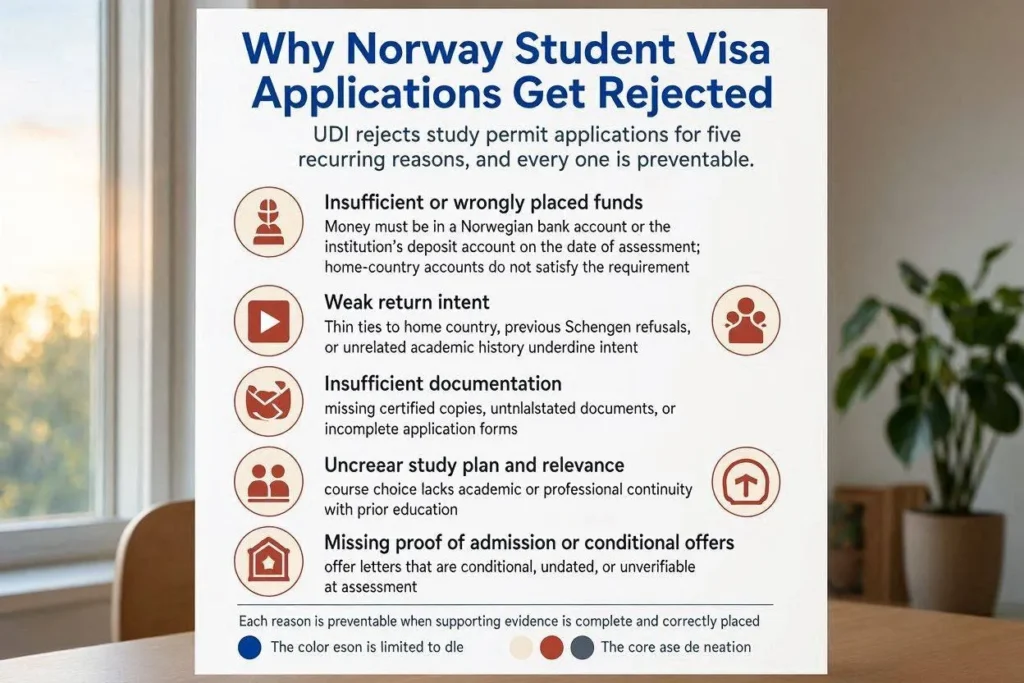
UDI rejects study permit applications for five recurring reasons, and every one is preventable.
- Insufficient or wrongly placed funds. Money in a home-country account fails the requirement; the funds must sit in a Norwegian bank account or the institution’s deposit account on the date of assessment.
- Weak return intent. Thin ties to the home country, previous visa refusals from Schengen states, or an academic history unrelated to the chosen programme trigger doubt about your plan to leave after graduation.
- Part-time or unaccredited study. Admission to a programme missing from the NOKUT list, or any part-time enrolment, produces automatic refusal.
- Incomplete documentation. A missing UDI checklist, an admission letter without programme dates, or an expired passport stalls and then sinks the case.
- Inconsistent information. Contradictions between your application form, bank documents, and admission letter read as credibility problems.
A rejected applicant can appeal within three weeks of the decision. UDI reviews the appeal first; when UDI maintains the refusal, the case moves to the Immigration Appeals Board (UNE) for a final decision. Appeals succeed most often when the applicant fixes a documentation gap — new funding proof, for example — rather than re-arguing identical facts.
Staying in Norway After Graduation
Graduates can apply for a job-seeker residence permit lasting up to 6 months to find skilled work in Norway. The permit requires proof that you qualified as a skilled worker through your Norwegian degree, plus funds to support yourself during the search.
A signed job offer converts your status: apply for a skilled worker residence permit, which — unlike the study permit — counts toward permanent residence. Norway’s labour market rewards graduates in energy, shipping, technology, and healthcare, and business graduates from institutions such as BI Norwegian Business School and the Norwegian School of Economics (NHH) enter one of Europe’s highest-salary economies.
Bringing Family Members to Norway
Your spouse, cohabitant, and children can apply for family immigration to join you, if you study at a university, university college, or vocational school. Folk high school and bible school students receive no family immigration rights.
Plan for a practical constraint in 2026: UDI currently lacks the capacity to process a family member’s application simultaneously with the student’s application, so partners and children of degree students face a separate, later timeline. The financial requirement rises when family members join, so recalculate your documented funds before both applications.
Conclusion
A Norway student visa in 2026 demands four proofs — admission, NOK 170,368 in a Norwegian account, housing, and return intent — plus a NOK 5,400 fee and an application submitted before 1 July for an autumn start. The process rewards preparation: transfer funds early, book the VFS Global or embassy appointment the day your admission letter lands, and match every figure across your documents. Students who clear these steps gain more than a permit — 20-hour weekly work rights, a path to a 6-month job-seeker permit, and access to tuition-free public education for EU/EEA citizens or globally ranked programmes for everyone else. Norway remains one of the safest, highest-quality study destinations in Europe, and the permit process, while strict, is transparent from first click to residence card.
FAQs

Michael Reynolds
Michael Reynolds leads ImmigrationWin’s immigration, visa, and global mobility content division. He specializes in researching immigration policies, visa requirements, application processes, and international relocation pathways for individuals, families, students, and professionals. With extensive experience analyzing immigration regulations and official government guidance, Michael brings a research-driven approach to complex immigration topics and changing visa policies. He is the primary author of ImmigrationWin’s visa guides, immigration resources, and country-specific content, helping readers better understand their options and make informed decisions about their international journey.
Related Posts