Japan Visa Types 2026: Complete Guide to All Categories
Japan offers 29 official visa categories, called statuses of residence (在留資格, zairyū shikaku), covering tourism, study, skilled work, family, and long-term residency. You choose your Japan visa type based on your purpose, planned stay length, and employment status.
Japan’s Ministry of Foreign Affairs (MOFA) issues visas at embassies and consulates abroad. The Immigration Services Agency (ISA) manages statuses of residence once you arrive. The 2 terms overlap in everyday use, so this guide covers both. Understanding the right category before you apply saves weeks of processing time and reduces rejection risk.
What Is the Difference Between a Japan Visa and a Status of Residence?
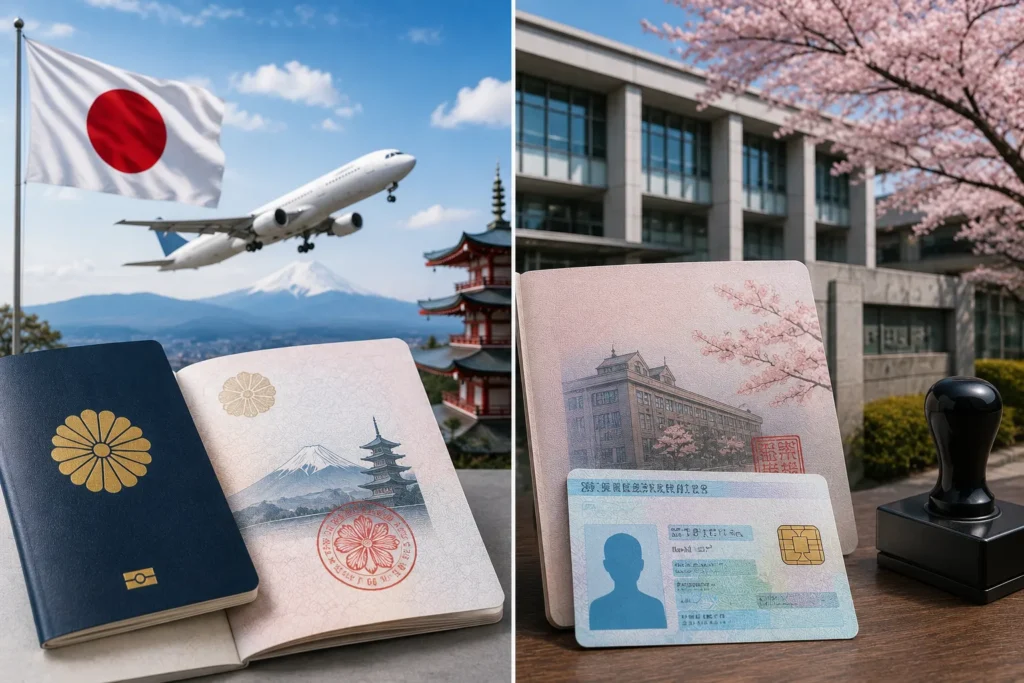
A visa (査証, sashō) grants you permission to board a flight to Japan. A status of residence determines what you can do in Japan and for how long. Both govern your entry, but 2 separate agencies manage them.
MOFA issues the visa at Japanese embassies and consulates abroad. ISA manages the status of residence at immigration offices inside Japan. When people say they are “changing their visa,” they almost always mean changing their status of residence at a regional immigration bureau. You cannot apply for either document after you enter Japan.
Citizens of 74 exempt countries, including the United States, Canada, Australia, and the United Kingdom, skip the visa step for short tourist stays of up to 90 days. Long-term stays, work, and study always require both a visa and a valid status of residence.
Japan Tourist Visa Types: Temporary Visitor and eVISA Options
The Temporary Visitor visa covers tourism, family visits, short business meetings, and transit stays of up to 90 days. Japan’s eVISA system, launched in 2024 and expanded in 2026, lets eligible travelers apply online without visiting an embassy.
As of May 15, 2026, the eVISA system accepts applicants from 9 countries: Australia, Brazil, Cambodia, Canada, Saudi Arabia, South Africa, Taiwan, the United Kingdom, and the United States. Travelers from additional territories, including Hong Kong, India, Indonesia, Singapore, and the UAE, apply through their local Japanese consulates. The eVISA covers single-entry tourist stays only, with a period of stay of 15 to 90 days depending on nationality.
How to Apply for a Japan Tourist Visa
To apply for a Japan tourist visa, gather your valid passport, a completed application form, 1 recent passport-sized photograph, proof of return or onward travel, and proof of sufficient funds. Processing takes approximately 5 business days at most embassies, though MOFA advises applying 3 to 4 weeks before your travel date. Apply at least 6 weeks before travel if your application requires a consulate interview.
You submit your application at the Japanese embassy or consulate with jurisdiction over your place of residence. You cannot apply inside Japan. Applicants from countries not covered by the eVISA system must apply in person or through an accredited travel agency.
Japan Visa Waiver Countries and Conditions
To enter Japan without a visa, your passport must be from one of the 74 exempt countries listed by MOFA. Visa-exempt nationals receive a Temporary Visitor landing permission for 15 to 90 days upon arrival, depending on nationality. The United States, UK, Canada, Australia, and most EU member states qualify for 90 days. Exempt travelers still face standard immigration screening and must show proof of onward travel and sufficient funds.
Japan plans to introduce the JESTA (Japanese-version Electronic System for Travel Authorization) by 2030. JESTA will require visa-exempt visitors to obtain pre-travel authorization online, similar to the US ESTA system. No mandatory JESTA requirement exists as of July 2026.
Japan Work Visa Types: Categories for Skilled Professionals
Japan offers 18 work-related statuses of residence, each tied to a specific occupation or industry. You must work only within the field your visa authorizes. Changing jobs to a different field requires a status change at the regional immigration bureau.
The most common work status is the Engineer/Specialist in Humanities/International Services visa, which covers IT engineers, designers, marketing professionals, interpreters, and foreign language instructors. Applicants need a job offer from a Japanese employer and a Certificate of Eligibility (COE) filed by that employer with the ISA.
How to Obtain a Certificate of Eligibility for a Work Visa
To obtain a Certificate of Eligibility, your Japanese employer files an application with the nearest regional immigration bureau on your behalf. COE processing takes 1 to 3 months. Your employer mails the approved COE to you. You then bring the COE to your local Japanese embassy to receive the actual visa sticker. Without the COE, the embassy will not issue a long-term visa.
Required COE documents include your employer’s company registration, your employment contract, your academic or professional qualifications, and your passport copy. Some positions, such as certain intra-company transfers under the Intra-Company Transferee status, carry additional document requirements.
Highly Skilled Professional Visa and Points-Based System
The Highly Skilled Professional (HSP) visa uses a points system based on your educational background, career history, annual income, and other qualifying factors. Applicants who score 70 or more points qualify for HSP status, which grants a 5-year residence period and a faster path to permanent residency.
Japan introduced 2 accelerated HSP tracks in 2023. The J-Skip visa targets earners with an annual income of JPY 20 million (approximately USD 130,000) or graduate-degree holders with substantial experience. J-Skip holders qualify for permanent residency after 1 year. The J-Find visa targets graduates of the world’s top-ranked universities, allowing them to live in Japan for up to 2 years to search for jobs or plan a startup, without a sponsor.
Specified Skilled Worker Visa: Japan’s Labor Shortage Response
The Specified Skilled Worker (SSW) program fills critical labor gaps in 16 designated industries, including food service, construction, shipbuilding, nursing care, agriculture, and — as of 2024 — the automotive transport and railway sectors.
The program has 2 tiers. SSW Type I allows stays of up to 5 years in total, requires a skills assessment test and Japanese language test, and does not permit you to bring family members. SSW Type II permits indefinite renewals and full family sponsorship, making it a realistic pathway to permanent residency. As you research other countries’ employer-sponsored programs, such as those detailed in our guide to Canada visa types, you will notice Japan’s sector-specific approach is unusually narrow by design.
Japan Student Visa: Requirements for International Students
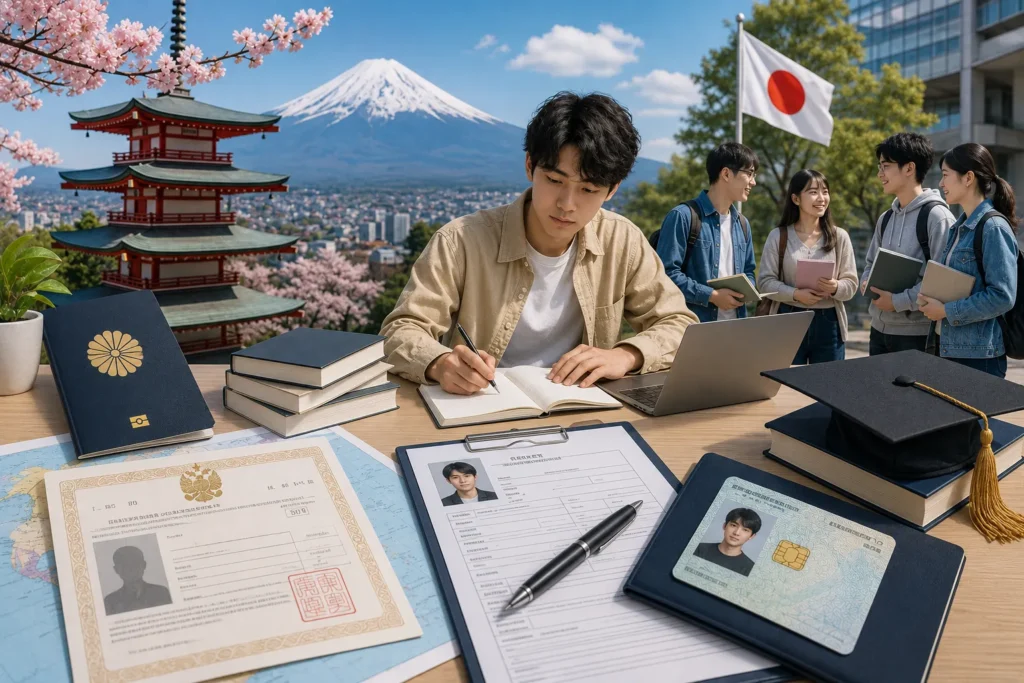
The Japan Student visa (Ryugaku) covers enrollment at accredited universities, junior colleges, vocational schools, and Japanese language schools. The ISA issues residence periods of up to 4 years and 3 months, depending on your program length.
To apply, your school in Japan applies for a COE on your behalf. Once the COE arrives, you take it to the Japanese embassy in your country and apply for the student visa. Student visa holders may work part-time for up to 28 hours per week during term and full-time during scheduled breaks, with a permission to engage in activity other than that permitted under status of residence stamp from the immigration bureau.
After graduation, students who find a job offer can apply for the Designated Activities (Job Hunting) status for up to 1 year while they transition to a work visa. This bridging status keeps your legal residence valid during the job search period.
Japan Family and Long-Term Visa Types for Spouses and Dependents
Japan offers 4 family and long-term residence categories: Spouse or Child of Japanese National, Spouse or Child of Permanent Resident, Long-Term Resident, and Dependent.
The Spouse or Child of Japanese National status carries no work restrictions. You work in any industry without a separate work authorization. Residence periods run from 6 months to 3 years, renewable at the immigration bureau. The Long-Term Resident category covers individuals of Japanese ancestry, Indochinese refugee settlers, and spouses of Japanese nationals left behind in China. Long-term residents also face no work restrictions.
The Dependent visa covers spouses and children of foreign nationals who hold a work or study visa. Dependents may work up to 28 hours per week with a separate permission stamp, and full-time if their sponsor holds an HSP or certain other statuses.
Japan Digital Nomad Visa and New 2024–2026 Categories
Japan launched the Digital Nomad visa under the Designated Activities status in March 2024. Remote workers from over 50 eligible countries can stay in Japan for up to 6 months to work for their overseas employers. Applicants must show an annual income of at least JPY 10 million (approximately USD 65,000) and hold private health insurance. Family members may accompany the primary applicant.
This category addresses a gap that competitors across Asia, such as those covered in our China visa types guide, have not yet filled for remote-first workers. The Digital Nomad visa does not permit you to work for a Japanese employer or client during the 6-month stay.
Japan Permanent Residency and Naturalization Pathways
Japan Permanent Residency (PR) grants indefinite residence and unrestricted work rights. The residence card requires renewal every 7 years, but your status itself carries no expiry date.
Standard PR requires 10 years of continuous legal residence, with at least 5 of those years spent working or living as the spouse of a Japanese national. HSP holders with 70 points qualify after 5 years. J-Skip holders with 80 or more points qualify after 1 year. Good conduct, stable income, and a clean tax and social insurance payment history are required for all PR applicants.
Naturalization requires 5 years of residence, renunciation of your original citizenship (Japan does not recognize dual citizenship for adults), demonstrated Japanese language ability, and stable income. Applications go through the Ministry of Justice, not MOFA.
Whether you are targeting Japan, Canada, or another destination, our immigration consulting services cover every stage from COE filing to permanent residency applications.
Japan Visa Types 2026: Quick Reference Table
| Visa Type | Typical Duration | Application Method | Difficulty |
| Temporary Visitor (Tourist) | 15–90 days | eVISA online or embassy | Easy |
| Student (Ryugaku) | 1–4 years 3 months | COE + embassy application | Moderate |
| Engineer/Humanities/International | 1–5 years, renewable | COE + embassy application | Moderate |
| Highly Skilled Professional (HSP) | 5 years fast-track | COE + points assessment | Hard |
| Specified Skilled Worker Type I | Up to 5 years total | COE + skills test | Hard |
| Specified Skilled Worker Type II | Indefinite renewal | COE + advanced skills test | Hard |
| J-Find (Future Creation Individual) | Up to 2 years | Embassy application, no sponsor | Moderate |
| J-Skip (Special HSP) | 5 years; 1-yr PR path | COE + income/degree proof | Hard |
| Digital Nomad (Designated Activities) | Up to 6 months | Embassy application | Moderate |
| Spouse of Japanese National | 6 months–3 years | COE + embassy application | Moderate |
| Permanent Residence | Indefinite | ISA application in Japan | Very Hard |
How to Apply for a Japan Visa: Step-by-Step Process
To apply for a Japan long-term visa, follow these 4 steps:
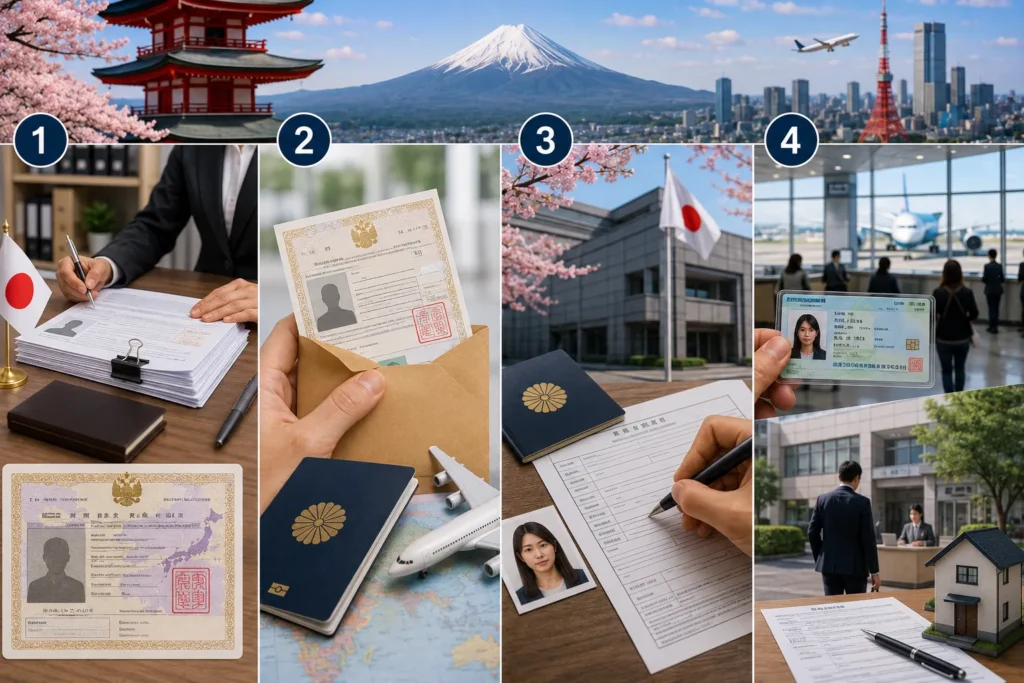
- Step 1 — COE Application: Your employer, school, or Japanese spouse files a COE request with the regional ISA bureau. Processing takes 1 to 3 months.
- Step 2 — COE Delivery: The ISA mails the approved COE to you outside Japan. A copy is acceptable for the visa application.
- Step 3 — Visa Application: You take the COE, your passport, a passport photo, and the application form to the Japanese embassy with jurisdiction over your residence. Processing takes approximately 5 business days.
- Step 4 — Entry and Residence Card: You enter Japan and receive your zairyu card (residence card) at major international airports. Register your address at the local municipal office within 14 days.
For short-term tourist visas, skip the COE step entirely. Apply directly at the embassy or through the eVISA portal if your country qualifies. Japan’s Visit Japan Web platform lets you complete immigration and customs arrival forms digitally before your flight, reducing airport processing time.
Choose the Right Japan Visa Type Before You Apply
Japan’s 29 visa categories address every type of traveler — from the tourist spending 2 weeks in Tokyo to the engineer building a 10-year career in Osaka. Match your purpose to the correct category, gather your documents before starting the COE process, and apply to the Japanese embassy with jurisdiction over your home country.
Applying under the wrong category leads to rejection, delays, and — in some cases — a ban from reapplying for a set period. Get your application right the first time. The team at Immigration Win specializes in Japan visa applications, COE filing, and long-term residency planning. Visit our immigration consulting services page to book a free consultation and review your eligibility today.
Frequently Asked Questions

Michael Reynolds
Michael Reynolds leads immigration content at ImmigrationWin, covering visa requirements, application and relocation pathways. He researches immigration policies and official government guidance to explain changing rules clearly. His guides help students, families, and professionals make informed decisions about moving abroad.
Related Posts