
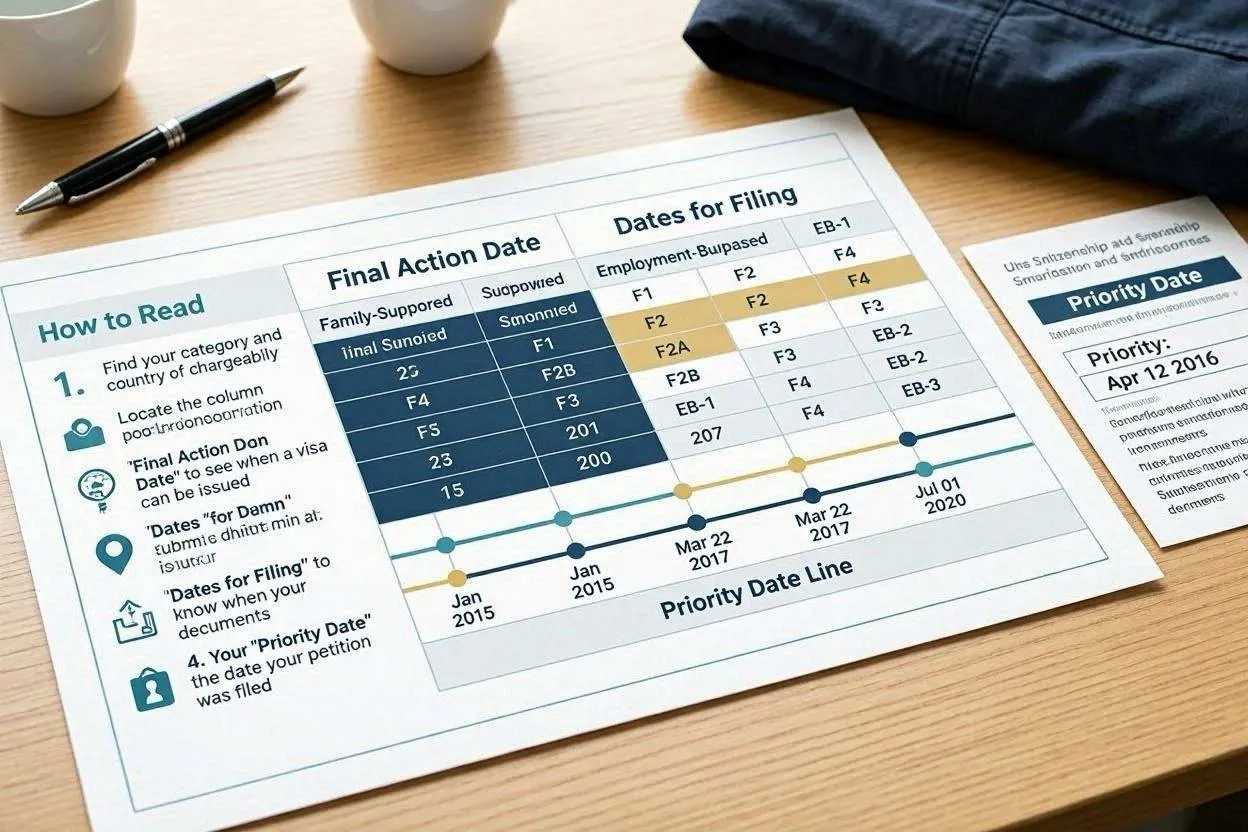
US Visa Bulletin: How to Read It, Priority Dates & What It Means
The US Visa Bulletin controls when you can take the next step toward your green card — and most applicants misread it.
Every month, the U.S. Department of State (DOS) publishes this document. It lists cutoff dates for every immigrant visa category and country of birth. Your position in the green card queue depends entirely on one thing: whether your priority date is earlier than the cutoff date shown in the bulletin for your category.
Get that comparison right and you file at the right time. Get it wrong and USCIS rejects your application — costing you months and hundreds of dollars in wasted fees.
This guide covers exactly how the bulletin works, how to read both charts, where to find your priority date, what the July 2026 bulletin means for key categories, and how to track monthly changes without missing a filing window.
What Is the US Visa Bulletin?
The US Visa Bulletin is a monthly document that shows which immigrant visa applicants can move forward with their green card application based on their preference category and country of birth.
Congress limits the total number of green cards issued each year. The annual cap is 140,000 for employment-based categories and 226,000 for family-sponsored categories. Immediate relatives of U.S. citizens — spouses, unmarried children under 21, and parents — fall outside these caps and are not subject to waiting.
When demand in a category exceeds the annual supply, a queue forms. The Visa Bulletin manages that queue by publishing cutoff dates each month. When the published date reaches or passes your priority date, your number is current and you can proceed.
DOS publishes the bulletin monthly, typically between the 8th and 12th of each month, for the following month’s validity. The July 2026 bulletin, for example, was released on June 16, 2026, and governs filing eligibility throughout July.
Key fact: The Visa Bulletin does not grant green cards. It controls when applicants become eligible to file for one.
2 Charts in Every Visa Bulletin — and Why They Are Different
Every bulletin contains 2 separate charts. Using the wrong chart is the single most common mistake applicants make — and it results in outright rejection.
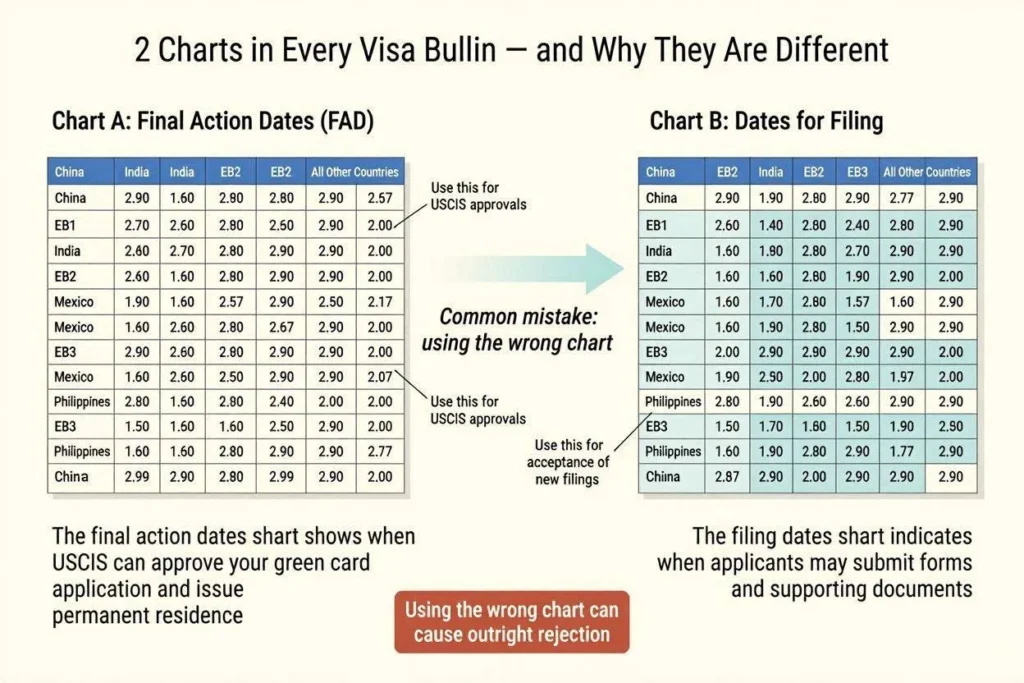
Chart A: Final Action Dates (FAD)
The Final Action Dates chart shows when USCIS can approve your green card application and issue permanent residence.
This is the primary chart. For consular processing cases handled through a U.S. Embassy abroad, Chart A always applies. For adjustment of status (AOS) applicants inside the U.S., Chart A applies unless USCIS specifically announces that Chart B is available for that month.
If your priority date is earlier than the date listed in Chart A for your category and country, USCIS can approve your case right now.
Chart B: Dates for Filing (DFF)
The Dates for Filing chart shows when you can submit Form I-485 even if your green card is not yet ready to be issued.
Chart B dates are typically a few months ahead of Chart A. Filing under Chart B lets you lock in your place, gain access to work authorization through Employment Authorization Document (EAD) and travel through Advance Parole — before the final approval stage.
USCIS decides each month whether to activate Chart B for employment-based or family-based categories. That announcement appears on uscis.gov separately from the bulletin itself. Always check the USCIS website before filing — not just the bulletin.
Chart A vs. Chart B — Quick Comparison
| Feature | Chart A — Final Action Dates | Chart B — Dates for Filing |
| Controls | Green card approval | I-485 submission eligibility |
| Always active? | Yes | Only when USCIS activates it |
| Applies to consular cases? | Yes | No |
| Benefit of filing under it | Receives green card | Gets EAD + Advance Parole sooner |
| Where to confirm | Visa Bulletin itself | uscis.gov monthly announcement |
What Is a Priority Date and How to Find Yours
Your priority date is the date your immigrant petition was officially received — either by USCIS or the Department of Labor.
The priority date determines your place in line. 3 common scenarios set a priority date:
- Employment-based via I-140: The date USCIS received your Form I-140 (Immigrant Petition for Alien Workers)
- Employment-based via PERM: The date the Department of Labor (DOL) received your PERM labor certification application — which comes before the I-140
- Family-based via I-130: The date USCIS received your Form I-130 (Petition for Alien Relative)
To find your priority date, check your Form I-797 Notice of Action — the approval notice USCIS sends after processing your petition. The priority date appears clearly on that document.
Your country of chargeability is your country of birth, not citizenship or current residence. An Indian-born applicant with Canadian citizenship still uses the India column in the bulletin.
Important: Chargeability follows country of birth — always. A Pakistani citizen born in India uses the India column for EB-2.
Preference Categories Explained: Employment-Based and Family-Sponsored
Employment-Based (EB) Preference Categories
Congress allocates at least 140,000 employment-based immigrant visas each fiscal year (FY), which runs October 1 through September 30. These visas divide into 5 preference categories:
| Category | Who Qualifies | Annual Cap (approx.) |
| EB-1 | Extraordinary ability (EB-1A), outstanding professors and researchers (EB-1B), multinational executives (EB-1C) | ~40,000 |
| EB-2 | Advanced degree holders and exceptional ability; includes EB-2 National Interest Waiver (NIW) | ~40,000 |
| EB-3 | Skilled workers (2+ years training), professionals (bachelor’s degree), other workers | ~40,000 |
| EB-4 | Special immigrants — religious workers, certain broadcasters, military members, Iraqi translators | ~10,000 |
| EB-5 | Immigrant investors — minimum $1,050,000 (or $800,000 in targeted areas) | ~10,000 |
Family-Sponsored (F) Preference Categories
Family-sponsored immigrant visas are capped at 226,000 annually, split across 4 preference tiers. Immediate relatives of U.S. citizens are unlimited and not subject to the bulletin.
| Category | Relationship |
| F1 | Unmarried adult children (21+) of U.S. citizens |
| F2A | Spouses and unmarried children (under 21) of lawful permanent residents |
| F2B | Unmarried adult children (21+) of lawful permanent residents |
| F3 | Married children of U.S. citizens |
| F4 | Siblings of adult U.S. citizens |
Each category has its own priority date cutoff in the bulletin. The per-country limit caps any single country at 7% of the total annual allocation — approximately 25,620 visas across employment and family categories combined.
How to Read the Visa Bulletin Step by Step
To read the visa bulletin correctly, follow these 5 steps in order:
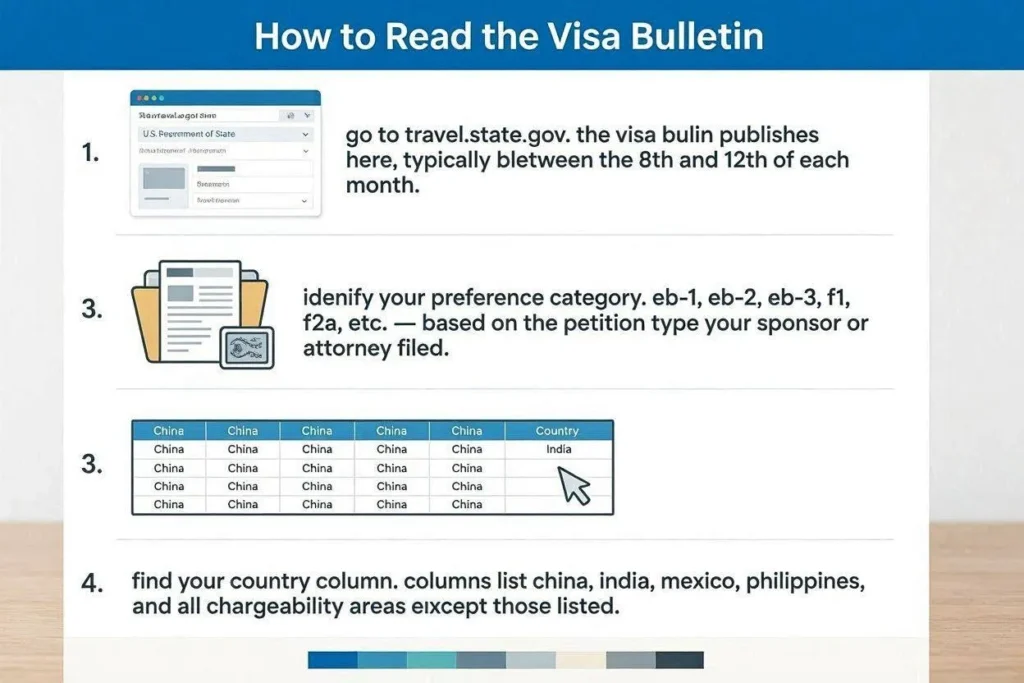
- Go to travel.state.gov. The Visa Bulletin publishes here, typically between the 8th and 12th of each month.
- Identify your preference category. EB-1, EB-2, EB-3, F1, F2A, etc. — based on the petition type your sponsor or attorney filed.
- Find your country column. Columns list China, India, Mexico, Philippines, and All Chargeability Areas Except Those Listed. Use the column that matches your country of birth.
- Compare the cutoff date to your priority date. If your priority date is earlier than the listed date, your number is current. If it is later, you wait for the date to advance.
- Check USCIS.gov to confirm which chart applies this month. USCIS announces monthly whether Chart A or Chart B governs AOS filings. Read this announcement before filing Form I-485.
One quick note on reading the dates: the bulletin uses DD-MMM-YY format. A date showing 01OCT13 means October 1, 2013. A listing of “C” means Current — no cutoff exists and all applicants in that category can file regardless of priority date.
“C” in the bulletin means Current — you can file or receive approval immediately with no priority date restriction.
Visa Bulletin July 2026: Key Category Movements
The July 2026 Visa Bulletin shows significant movement in several categories — and retrogression in others. Here is what changed and what it means for active applicants.
Employment-Based Categories — July 2026
| Category | Country | July 2026 Final Action Date | Change from June |
| EB-1 | All areas / Mexico / Philippines | Current (C) | No change |
| EB-1 | China | April 1, 2023 | No change |
| EB-1 | India | October 15, 2022 | Retrogressed ~2 months from Dec 15, 2022 |
| EB-2 | All areas / Mexico / Philippines | Current (C) | No change |
| EB-2 | China | September 1, 2021 | No change |
| EB-2 | India | September 1, 2013 | Retrogressed ~10.5 months from July 1, 2014 |
| EB-3 | China | December 22, 2021 | Advanced ~5 months from August 1, 2021 |
| EB-3 | India | Contact attorney | Check bulletin — limited movement |
| EB-5 | India | Unavailable | Annual limit reached for FY2026 |
India EB-1 and EB-2 retrogression in July 2026 is driven by high demand exhausting the FY2026 annual limit. The Department of State warned that further retrogressions are possible before September 30, 2026. FY2027 begins October 1, 2026, which typically brings significant forward movement as fresh visa numbers reset.
Family-Based Categories — July 2026
For family-based categories in July 2026, USCIS continues using the Dates for Filing chart — meaning eligible applicants can submit Form I-485 under Chart B dates.
- F1 moved forward 5 months across all chargeability countries
- F2B, F3, and F4 each gained approximately 2 months
- F2A remains current for most countries
What Is Visa Retrogression?
Visa retrogression happens when the Department of State rolls a cutoff date backward because demand has exhausted the annual visa allocation for that category faster than expected.
When retrogression hits, priority dates that were current last month become unavailable. Applicants who had not yet filed lose their window. Approved I-485 applications already on file stay on file and are not abandoned — but no new approvals issue until the date advances again.
Retrogression hits India and China employment-based categories most frequently because per-country limits apply equally to all countries regardless of applicant volume. India and China generate far more applicants than most countries but receive the same 7% annual cap.
A concrete example: EB-2 India showed September 1, 2012 as the Final Action Date in March 2026 bulletins. The April 2026 bulletin retrogressed that date to January 1, 2012 — cutting off anyone with a priority date between those 2 dates who had not yet filed.
Retrogression risk is highest in August and September as the federal fiscal year ends. Monitor bulletins monthly — especially if your date is within 18 months of the current cutoff.
Annual Visa Limits for FY 2026
The Immigration and Nationality Act (INA) sets firm annual caps. These numbers govern the entire bulletin system:
| Visa Type | Annual Cap (FY 2026) | Per-Country Limit |
| Employment-based (all EB categories) | 140,000 | 7% of total = ~25,620 |
| Family-sponsored preference | 226,000 | 7% of total = ~25,620 |
| Diversity Visa (DV) Lottery | ~52,000 (reduced from 55,000) | 7% per country |
| Immediate relatives of U.S. citizens | Unlimited | No per-country cap |
Unused visa numbers in one category can roll over to another within the same preference tier. Employment-based unused numbers can also flow to family-sponsored categories under INA rules — which is one reason why category movements do not always follow a predictable pattern month to month.
How to Track the Visa Bulletin Every Month
Missing a single bulletin can mean missing a filing window that does not reopen for years. These 5 actions keep you informed without spending hours on it:
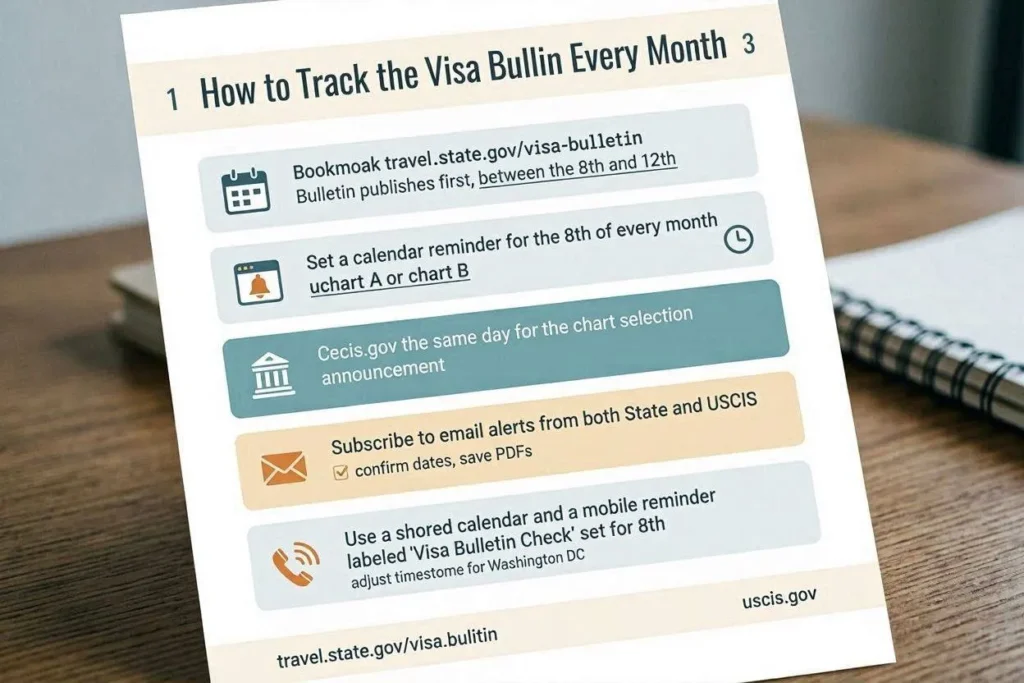
- Bookmark travel.state.gov/visa-bulletin. The bulletin publishes here first, between the 8th and 12th of each month. Set a calendar reminder for the 8th of every month.
- Check uscis.gov the same day. USCIS posts its chart selection announcement here. Confirm whether Chart A or Chart B applies for AOS filings before taking any action.
- Track your priority date window actively. Start monitoring monthly once your priority date comes within 24 months of the current cutoff for your category.
- Sign up for DOS email alerts. The Department of State offers email notification when new bulletins publish at travel.state.gov.
- Use an immigration attorney for categories near movement. For India EB-1, EB-2, or any category approaching current status, an attorney can flag filing windows the moment they open — I-485 packages take time to prepare and windows can close within weeks.
Cross-Chargeability: A Strategy Many Applicants Miss
Cross-chargeability lets a principal applicant use a spouse’s country of birth for chargeability if the spouse’s country has an earlier cutoff date.
Both spouses must be filing together as co-applicants. The rule exists to prevent family separation in cases where one spouse faces a longer wait than the other.
Example: An Indian-born principal applicant in EB-2 faces a cutoff in early 2013. The applicant’s spouse was born in Germany. Germany falls in the All Chargeability Areas column, which is Current. The principal can use the spouse’s Germany chargeability to file immediately — eliminating years of waiting.
Not every case qualifies. Both spouses must be filing together at the same time. An immigration attorney should confirm eligibility before relying on cross-chargeability in a filing.
Child Status Protection Act (CSPA): Protecting Children from Aging Out
The Child Status Protection Act (CSPA) protects children from losing eligibility when they turn 21 while a visa petition is pending.
Under immigration law, a child is defined as an unmarried person under 21. If a child turns 21 before a visa number becomes available, the child risks aging out of the preference category and losing derivative status.
CSPA calculates a protected age by subtracting the time the petition was pending from the child’s actual age. If the calculated age stays below 21, the child retains eligibility. This calculation applies to both family-based and employment-based derivative beneficiaries.
CSPA does not protect children indefinitely. The child must take steps to seek the visa within 1 year of the priority date becoming current. A missed deadline eliminates CSPA protection.
Check Your Priority Date Now — Every Month Counts
The visa bulletin moves every 30 days. A category that is years away today can advance 6 months overnight. A category that is current today can retrogress just as fast.
3 things to do right now:
- Find your priority date. Pull your Form I-797 approval notice and note the date.
- Check this month’s bulletin. Go to travel.state.gov, find your category and country column, and compare that date to yours.
- Confirm the USCIS chart selection. Visit uscis.gov to see whether Chart A or Chart B governs AOS filings this month before taking any action.
If your priority date is within 24 months of the current cutoff, consult an immigration attorney now. Filing windows in retrogressing categories can close in a single month — and missing them adds years to your green card timeline.
Frequently Asked Questions

Michael Reynolds
Michael Reynolds leads ImmigrationWin’s immigration, visa, and global mobility content division. He specializes in researching immigration policies, visa requirements, application processes, and international relocation pathways for individuals, families, students, and professionals. With extensive experience analyzing immigration regulations and official government guidance, Michael brings a research-driven approach to complex immigration topics and changing visa policies. He is the primary author of ImmigrationWin’s visa guides, immigration resources, and country-specific content, helping readers better understand their options and make informed decisions about their international journey.
Related Posts