Australia Student Visa Interview Questions 2026: Complete Answer Guide
The Australia student visa interview is a short conversation with a Department of Home Affairs (DHA) officer or an authorized education agent that checks whether your study plans, finances, and intentions match what you wrote on your application. Not every applicant gets one. Some students are approved on paper alone, while others receive a call, a video link, or an in-person meeting request because their file needs a closer look. The interview usually runs 10 to 20 minutes, and it can happen any time between lodging your application and the final decision.
Skipping preparation is the single biggest risk here. An officer isn’t testing your English fluency or trying to trip you up — they’re comparing your spoken answers against your written application, your bank statements, and your Confirmation of Enrolment (CoE), the electronic document a Commonwealth Register of Institutions and Courses for Overseas Students (CRICOS)-registered provider issues once you accept an offer and pay your deposit.
Why the Department of Home Affairs Interviews Applicants
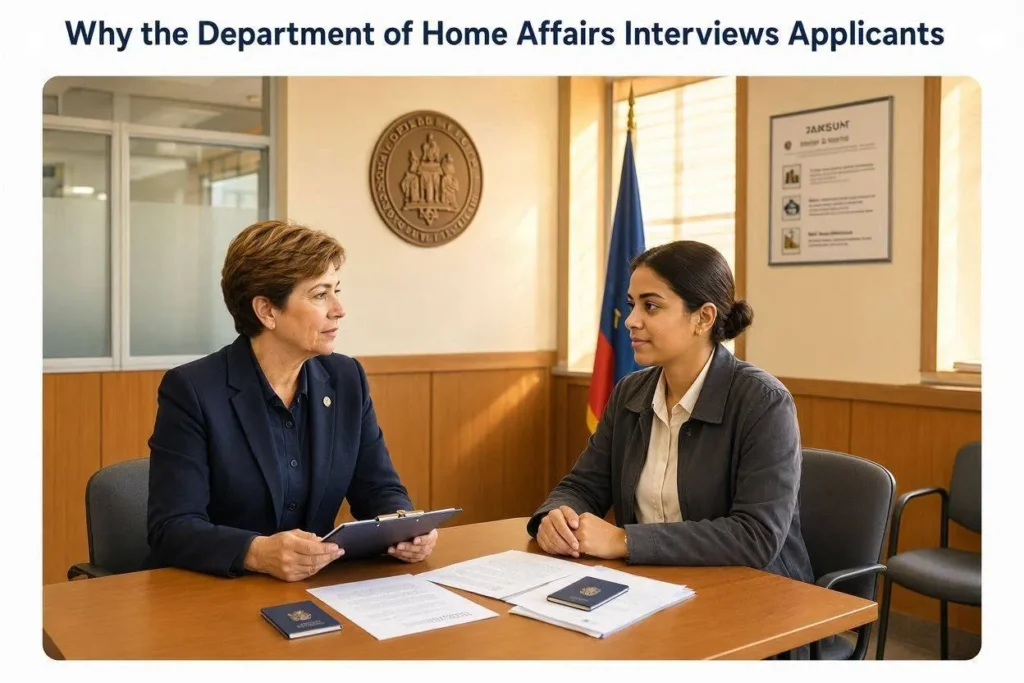
The Department interviews applicants to confirm three things: genuine study intent, financial capacity, and consistency between your documents and your spoken answers. Officers look for a clear academic pathway, honest answers about your finances, and a plausible reason to return home or move on legally after your course ends.
Discrepancies raise flags faster than weak English does. A student who claims their sponsor earns AUD 60,000 a year but submits payslips showing AUD 38,000 will face harder follow-up questions than a nervous student whose numbers line up. Consistency matters more than polish.
Genuine Student Requirement Replaces the Old GTE Statement
Yes, the Genuine Temporary Entrant (GTE) requirement no longer exists — the Department replaced it with the Genuine Student (GS) requirement on 23 March 2024. The GS test still checks your intent to study and comply with visa conditions, but it shifts the framing. Instead of proving you’ll leave Australia permanently after your course, you now need to show your course fits your background, your finances are genuine, and your circumstances support a temporary stay for education, even if a future skilled migration pathway later becomes relevant.
In practice, this changes how you should answer the classic “what will you do after graduation” question. Under the old GTE framing, mentioning any interest in staying to work would count against you. Under the GS framework, you can mention Australia’s post-study work options honestly, as long as you also explain how the course connects logically to your prior study or work history and describe a credible plan either way.
The GS requirement asks for a written statement submitted with your application, plus supporting evidence: academic transcripts, employment records, and a personal statement explaining why this specific course, at this specific institution, makes sense for you. The interview, when one happens, tests whether you can explain that same story out loud without contradicting what you wrote.
Subclass 500 and Subclass 485: How the Two Visas Connect
The Subclass 500 is the student visa itself, and the Subclass 485 is the Temporary Graduate visa many students apply for after finishing their course — officers sometimes ask about both in the same interview. A Subclass 500 lets you study full-time in a CRICOS-registered course and work up to 48 hours per fortnight while your course is in session, with no cap during scheduled breaks. A Subclass 485 lets eligible graduates stay and work in Australia for a set period after completing their degree, with the exact length depending on qualification level and location of study.
Officers sometimes ask whether you know the difference between the two visas, partly to confirm you understand visa conditions and partly to see whether your post-study plans sound informed rather than rehearsed. Naming both subclasses correctly, and explaining which conditions apply to which visa, signals genuine research rather than a memorized script.
Interview Format: Video Call, Phone, and In-Person
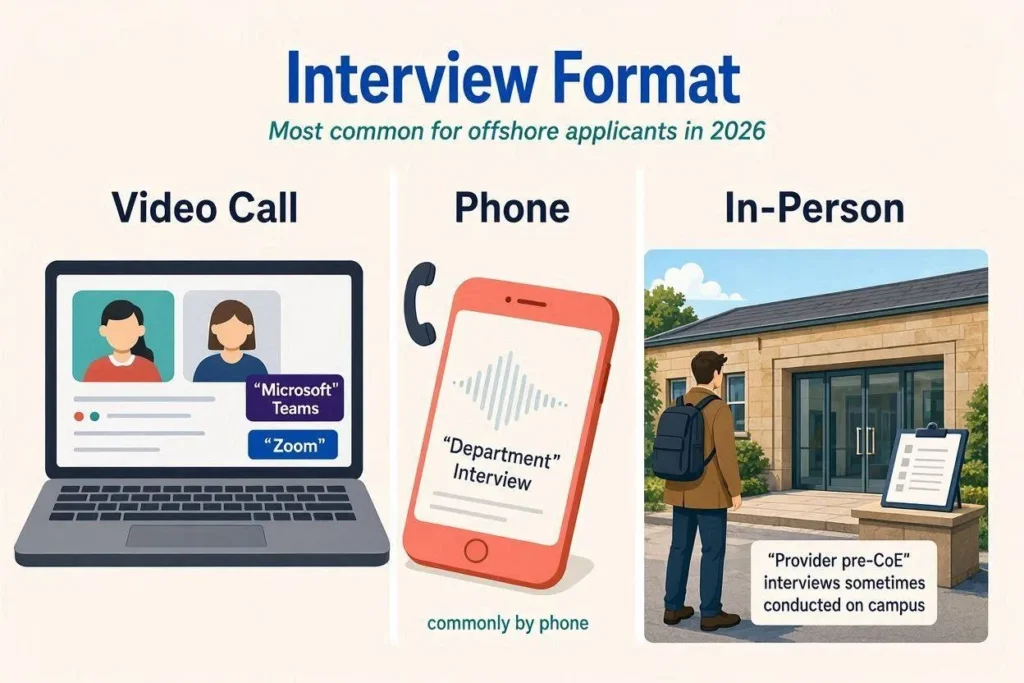
Australia student visa interviews happen over video call, phone, or in person, depending on your location and the education provider’s process — video is the most common format for offshore applicants in 2026. Some universities and colleges conduct their own pre-CoE interviews before the Department gets involved, often through Microsoft Teams or Zoom. The Department’s own interviews, when required, tend to happen by phone or in a scheduled visa office appointment.
Whichever format you get, treat it the same way. Sit somewhere quiet, keep your documents within reach but don’t read from a script, and confirm your connection works before the scheduled time. A dropped video call mid-interview creates unnecessary friction, and rescheduling isn’t guaranteed.
Australia Student Visa Interview Questions and Sample Answers
Questions About Your Course and University Choice
Officers ask about your course and university choice to confirm your academic pathway makes sense on paper and out loud. Expect direct questions rather than vague ones, and answer with specifics rather than marketing language.
- “Why did you choose this course?” Name the exact subjects or units that connect to your previous degree or work experience, for example: “My bachelor’s was in mechanical engineering, and this master’s in renewable energy systems builds directly on the thermodynamics coursework I completed in 2023.”
- “Why this university and not another one?” Cite something concrete: a specific lab, a named professor, an industry placement program, or a ranking in your exact discipline rather than the university overall.
- “Did you apply to other institutions?” Answer honestly. Mentioning two or three other applications and explaining why you picked this one shows research, not indecision.
Questions About Study Plans and Career Goals
Study-plan questions test whether your course leads somewhere specific, so vague answers about “a better future” tend to raise more questions than they answer.
- “What will you do after finishing your degree?” Give a concrete, honest plan. Under the GS framework, you can say you’d consider Subclass 485 work rights before returning home, provided you also explain the skills gap this course fills for your longer-term goals.
- “How does this course fit your career history?” Draw a straight line between your past study or job and the new qualification. A gap of several years without explanation invites follow-up questions, so address any gap directly with dates and reasons.
Questions About Your Finances
Financial questions carry the most weight in a student visa interview, because insufficient or unclear funding is one of the leading causes of refusal.
- “Who is paying for your studies?” Name the exact source: personal savings, a named parent or sponsor, an education loan, or a scholarship, and be ready to state the amount.
- “How much money do you have available, and where is it held?” Give a specific figure and bank name rather than a rounded estimate. Bank statements need to show funds held for at least three months before you lodge your application.
- “What happens if you run out of money?” Describe a backup plan: a second family sponsor, an emergency fund, or a specific relative who could assist, rather than saying you’d rely on part-time work.
Questions About Ties to Your Home Country
These questions assess whether your circumstances support a temporary stay for study, so answer with specific family, property, or career details rather than general statements of loyalty.
- “Do you have family responsibilities at home?” Mention dependents, aging parents, or a family business, if any apply to your situation.
- “What would you be doing if you weren’t studying in Australia?” Describe a real alternative — a job offer, a local program, or continued work — to show your decision to study abroad was deliberate rather than an attempt to leave permanently with no plan.
Questions About Accommodation and Living Arrangements
Accommodation questions confirm you’ve made real, checkable arrangements rather than vague plans to “figure it out” on arrival.
- “Where will you live?” Name the specific address or the type of accommodation you’ve booked: university halls, a homestay, or a private rental, along with the suburb.
- “How far is your accommodation from campus?” Give an actual distance or commute time, in kilometers or minutes, showing you’ve researched the location rather than guessed.
Questions About Family, Health Cover, and Visa Conditions
These questions check whether you understand the practical obligations that come with holding a Subclass 500 visa.
- “Are you traveling with a spouse or children?” Answer directly, since dependents affect both the financial requirement and the visa conditions attached to your grant.
- “Do you know what Overseas Student Health Cover (OSHC) is?” State that OSHC is compulsory health insurance for the full length of your student visa, and that you’ve arranged or budgeted for it.
- “Are you aware of your visa conditions?” Reference specific condition codes if you know them — condition 8202 requires you to remain enrolled and maintain satisfactory attendance, and condition 8105 limits your work hours to 48 per fortnight during term.
Current Financial Requirement for a Subclass 500 Visa
The 2026 living-cost threshold for a Subclass 500 visa is AUD 29,710 (roughly USD 19,300 or GBP 15,100) for a single applicant, with additional amounts required for family members. The Department adds AUD 10,394 for an accompanying spouse or de facto partner and AUD 4,449 for each dependent child. These figures cover 12 months of living costs and sit on top of your first year’s tuition fees and travel expenses — they aren’t a total budget, just the baseline the Department checks against your bank statements, loan approval letter, or scholarship documentation.
The Department reviews this figure annually, and it has climbed steadily: the living-cost threshold sat at AUD 21,041 in 2023 and rose to AUD 24,505 by early 2024 before reaching its current 2026 level. Applicants should always confirm the exact current figure on the Department of Home Affairs website before lodging, since indexation can shift the number between intakes.
What Happens After a Visa Refusal
If your Subclass 500 visa is refused, you may have the right to apply for merits review at the Administrative Review Tribunal (ART), the body that replaced the Administrative Appeals Tribunal (AAT) and the Immigration Assessment Authority (IAA) on 14 October 2024. Not every refusal carries review rights — your refusal letter states explicitly whether ART review is available to you.
Time limits are strict and non-negotiable. Applicants in immigration detention have 14 days to lodge a review application, while applicants outside detention generally have 28 days. Missing either deadline ends your review rights permanently, so read your refusal letter the same day it arrives and act immediately, rather than waiting to gather every document first.
Interview Preparation Checklist
Walk into your interview with these items ready, physically or digitally accessible, not just memorized:
- Valid passport and any previous visa records
- Confirmation of Enrolment (CoE) from your CRICOS-registered provider
- Bank statements covering at least three months, matching the exact figures you plan to state out loud
- Sponsorship letter, loan approval letter, or scholarship confirmation, whichever applies
- Proof of OSHC coverage for your full visa duration
- Accommodation confirmation or booking details
- A one-page summary of your course structure, so you can name specific units without hesitating
Common Mistakes That Lead to Refusal
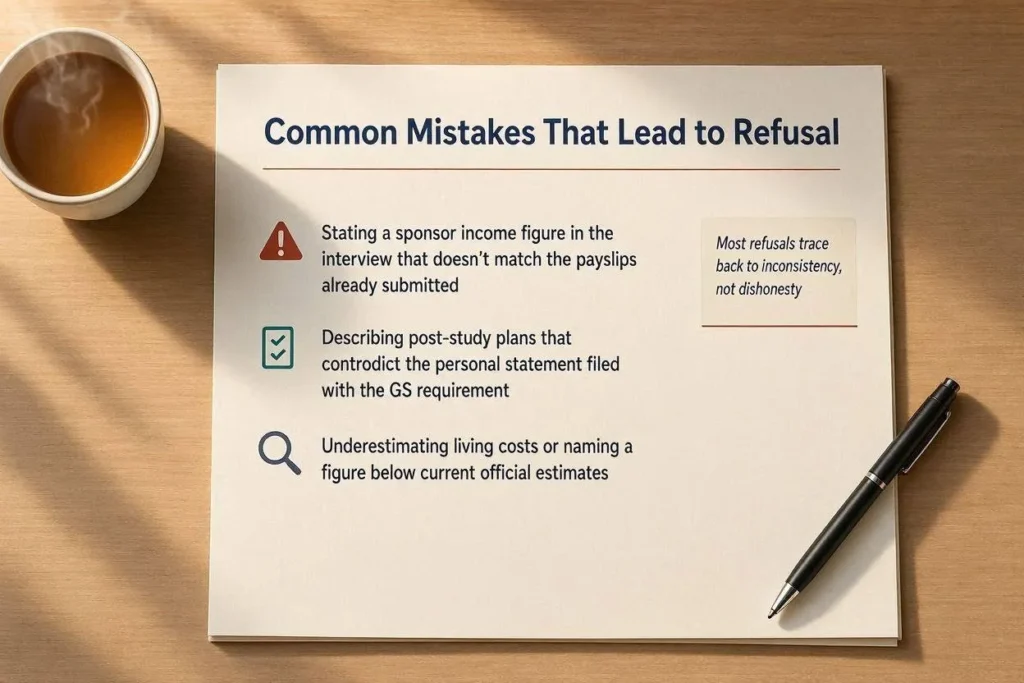
Most refusals trace back to inconsistency, not dishonesty — applicants forget what they wrote weeks earlier and contradict themselves out loud. Watch for these specific patterns:
- Stating a sponsor income figure in the interview that doesn’t match the payslips already submitted
- Describing post-study plans that contradict the personal statement filed with the GS requirement
- Underestimating living costs or naming a figure below the current AUD 29,710 threshold
- Giving vague answers about accommodation, such as “I’ll find something after I arrive”
- Reciting memorized phrases instead of answering the actual question asked
Before You Walk Into the Interview
An Australia student visa interview rewards preparation over performance. Officers aren’t looking for perfect English or a flawless script — they’re checking whether your course, your finances, and your plans hold together as one honest story. Know your numbers, know your course content, and answer the question actually asked rather than the one you rehearsed. That combination, more than any single phrase or sample answer, is what gets applications approved.
FAQs

Michael Reynolds
Michael Reynolds leads ImmigrationWin’s immigration, visa, and global mobility content division. He specializes in researching immigration policies, visa requirements, application processes, and international relocation pathways for individuals, families, students, and professionals. With extensive experience analyzing immigration regulations and official government guidance, Michael brings a research-driven approach to complex immigration topics and changing visa policies. He is the primary author of ImmigrationWin’s visa guides, immigration resources, and country-specific content, helping readers better understand their options and make informed decisions about their international journey.
Related Posts