New Zealand Student Visa Interview Questions: The Complete 2026 Guide
A New Zealand student visa interview is a short conversation with an Immigration New Zealand (INZ) Immigration Officer (IO) that confirms an applicant’s study intentions before a visa decision gets made. Most applicants never sit through one. For those who do, the officer wants clear, honest answers about the chosen course, its cost, and the applicant’s plans after graduation — not a test of academic knowledge.
This guide pulls together the actual questions applicants report being asked, sample answers that separate weak responses from strong ones, and the process details that most other guides leave out: how INZ contacts applicants, how long the call runs, and what the 2026 Pathway Student Visa changes mean for interview likelihood.
What Is a New Zealand Student Visa Interview?
A New Zealand student visa interview is a phone or video conversation between a visa applicant and an INZ Immigration Officer, held to verify that the applicant is a genuine student. The officer checks three things during the call: why the applicant chose a specific course, how that course connects to the applicant’s academic or work background, and whether the applicant genuinely intends to study rather than use the visa as a route to long-term residence.
The interview isn’t an academic exam. An officer won’t ask an engineering applicant to solve equations or a nursing applicant to name muscle groups. Instead, the questions target motivation, planning, and consistency between the application documents and the applicant’s spoken answers.
Do All Student Visa Applicants Get Interviewed?
No. Most student visa applications get approved without an interview ever taking place. INZ processes applications through three possible outcomes:
- Approval without an interview, which is the most common result
- Refusal without an interview, which happens when the application is clearly weak
- An interview, followed by either approval or refusal based on the applicant’s responses
Getting selected for interview doesn’t signal trouble. INZ generally only calls applicants whose documentation already looks solid enough to be near approval — the interview exists to close a specific gap in the officer’s confidence, not to reopen the whole case.
Why Immigration New Zealand Selects Applicants for Interview
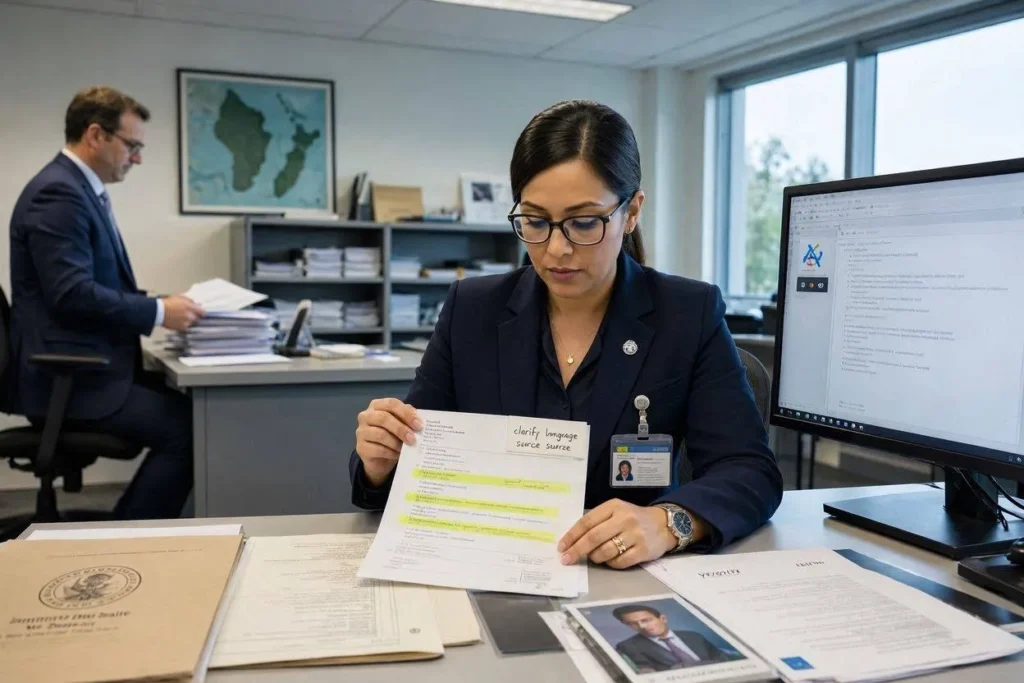
Immigration New Zealand selects applicants for interview when something in the Statement of Purpose (SOP) or supporting documents needs verbal confirmation. No published checklist explains exactly who gets called; the decision sits with the individual officer reviewing the file. Reported triggers include:
- An SOP that reads too polished for the applicant’s age or education level, suggesting an agent or an AI tool wrote it
- An SOP that stays vague about course choice or future goals
- A gap in the applicant’s study or employment history that the documents don’t explain
- A first-time application from a country with a higher historical refusal rate
An applicant who writes a personalized, specific SOP — one built from real reasoning rather than a template — reduces the odds of being flagged for a follow-up call.
How Immigration New Zealand Contacts Applicants
Immigration New Zealand contacts applicants either by email with a scheduled video call link or by an unscheduled phone call. Both methods appear regularly, and applicants should prepare for either one.
Email invitation. INZ sends a message containing a Microsoft Teams link along with a set date and time. This method gives the applicant days to rehearse answers and settle nerves before the call happens.
Unscheduled phone call. INZ dials the applicant directly from a New Zealand number, which starts with the country code +64. Applicants outside New Zealand receive these calls at odd local hours since INZ operates on New Zealand business time; an applicant in South Asia, for example, might get a call between 8:00 a.m. and 10:00 a.m. local time. Keeping a phone off silent mode during the visa processing period matters — a missed call from an unrecognized number can delay or damage an application.
If a call arrives at an inconvenient moment, an applicant may ask the officer for ten minutes to relocate somewhere quiet, though this request should reflect a genuine need rather than nerves alone.
How Long Does the Interview Last?
A New Zealand student visa interview typically runs 20 to 30 minutes, though some conclude in under 10 minutes. A short call isn’t automatically bad news, but applicants who notice the officer wrapping up after only a few exchanges should treat that as a signal the officer may have already reached a decision. Interviews tied to broader visitor or work visa categories sometimes run shorter, closer to 10 to 20 minutes, since the intent-verification bar differs from a study-specific visa.
Common New Zealand Student Visa Interview Questions
Officers draw from a fairly predictable question bank. Grouping the questions by category makes preparation more manageable than memorizing a random list.
Course and Education Provider Questions
- What course will you study, and what is the name of the institution?
- Why did you choose this particular course?
- Why did you choose this education provider over others?
- How many other education providers did you research before applying?
- Who referred you to this institution?
- What is the address of your college or university, and how far is it from the central business district by public transport?
- How many core units and elective units does your course include?
- Name six or seven units within your course.
- What professional accreditation does this course carry in New Zealand?
An applicant who can name three specific universities they compared, along with one concrete reason each was rejected — tuition cost, ranking, or course structure, for example — demonstrates the kind of research depth officers look for.
Academic Background and Study Gap Questions
- What is your academic history, including GPA, course name, and completion year?
- Did you take an extra year to complete any qualification, and why?
- Do you have any academic backlogs or failed subjects?
- What did you do during any gap in your education — training, internship, or paid work?
- What is your IELTS or PTE (International English Language Testing System or Pearson Test of English) score, broken down by band, and when did you sit the test?
- Have you applied for a student visa to any country before, including New Zealand?
Financial Questions
- How will you fund your tuition and living costs?
- What is your family’s monthly income, broken down by source?
- Have you received a scholarship, and if so, what conditions apply?
- What is the average cost of living for a student in New Zealand?
- How much does local travel cost in New Zealand?
- How will you arrange accommodation, and what will it cost per week?
Applicants should give a specific weekly or monthly figure supported by a bank statement, rather than a rounded estimate pulled from memory.
Future Plans and Ties to Home Country Questions
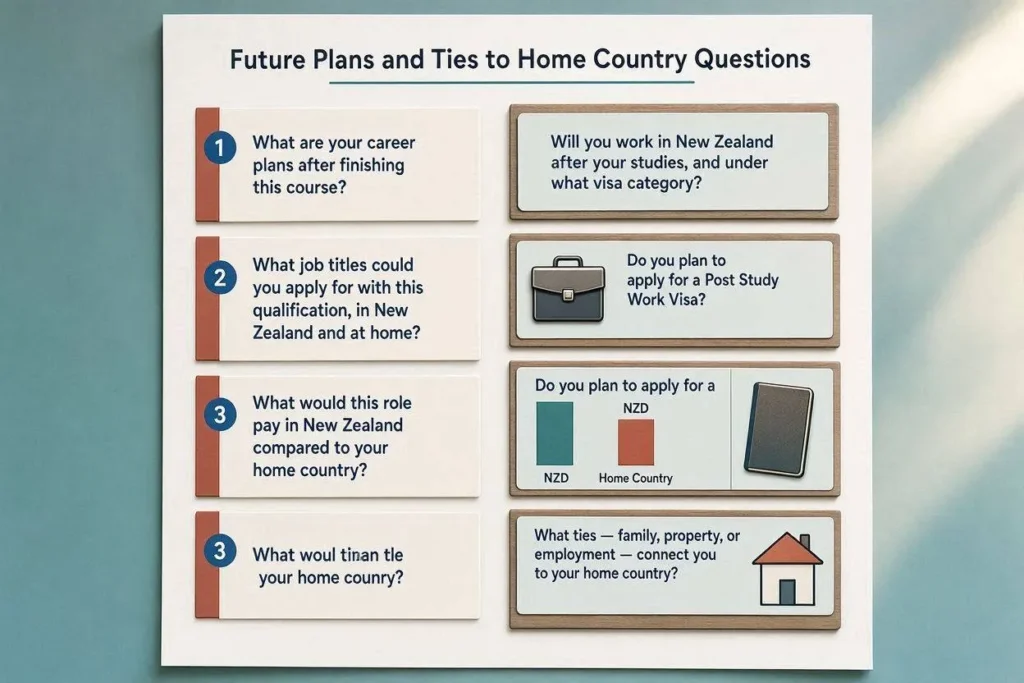
- What are your career plans after finishing this course?
- What job titles could you apply for with this qualification, in New Zealand and at home?
- What would this role pay in New Zealand compared to your home country?
- Will you work in New Zealand after your studies, and under what visa category?
- Do you plan to apply for a Post Study Work Visa?
- What ties — family, property, or employment — connect you to your home country?
Honesty matters more here than a rehearsed answer. An applicant who genuinely intends to apply for a Post Study Work Visa should say so directly; claiming an immediate return home when the financial and career details point elsewhere damages credibility fast.
Personal and Family Background Questions
- What is your full name, date of birth, and passport number?
- Are you married, and if so, what does your spouse do for work?
- What do your parents or siblings do professionally?
- Do you have relatives already living in New Zealand, and if so, what is their visa status?
Documents to Have Ready During the Interview
An applicant should keep their passport, offer letter, financial statements, and academic transcripts within reach during the interview, even though INZ conducts the call remotely. An officer occasionally references a specific figure or date from the submitted application, and an applicant who can confirm it instantly — a tuition amount or an IELTS test date, for example — comes across as consistent and prepared. Keep these five items nearby before the call starts:
- Passport and any prior visa approval letters
- Offer of place from the education provider
- Bank statements or the loan sanction letter submitted with the application
- Academic transcripts and English test score report
- A printed or digital copy of the submitted Statement of Purpose
None of these documents need to be shown on camera or read aloud verbatim. Their purpose is to keep the applicant’s spoken answers aligned with the paperwork already on file.
Video Call vs. Phone Call: What Changes
An applicant invited to a Microsoft Teams video interview should test the camera, microphone, and internet connection at least a day beforehand, since a technical failure mid-call can come across as unpreparedness even when the cause is unrelated to the application. Dress the same way for a video call as for an in-person meeting — a plain, tidy appearance signals seriousness without requiring formal wear. Sit in a well-lit room with a neutral background, and close any other application that might trigger a notification sound during the call.
A phone interview removes the visual element entirely, which shifts more weight onto tone of voice and pacing. Speaking slightly slower than normal conversation pace helps an officer catch details correctly the first time, reducing the number of follow-up clarification questions.
Weak Answers vs. Strong Answers
Officers rarely fail applicants over the questions themselves — the answers decide the outcome.
Weak answer: “I chose this course because it’s interesting and useful.” This response tells the officer nothing specific about the applicant as a person.
Strong answer: “I chose this course because a project at my current job showed me a gap in my technical skills, specifically in data analysis, and this program addresses that gap directly.” This response is personal, verifiable, and hard to fake in a follow-up question.
Weak answer: “I will return home right after finishing my studies.” This response sounds rehearsed, and it can contradict a Post Study Work Visa plan mentioned earlier in the same conversation.
Strong answer: “I plan to apply for a Post Study Work Visa to gain two years of local experience in my field, and then return home to join my family’s business with that experience behind me.” This response stays honest about intentions while still explaining a credible connection back to the home country.
Three habits separate strong answers from weak ones consistently:
- Give at least two to three sentences per question, not a single clipped phrase
- Explain the reasoning behind each choice, not just the choice itself
- Draw on one real, specific personal experience rather than a general statement
The 2026 Pathway Student Visa and Its Effect on Interviews
New Zealand introduced changes to the Pathway Student Visa that took effect on 20 July 2026, adjusting how multi-year study programs get assessed for visa purposes. Applicants using the Pathway Student Visa route — which covers consecutive enrollment across two or three connected qualifications — should confirm the current provider and course-sequence requirements directly with Immigration New Zealand or a Licensed Immigration Adviser before an interview, since officers may ask how a Pathway application aligns with the updated rules. Applicants on a standard single-course student visa aren’t affected by this change.
Common Mistakes That Lead to Visa Refusal
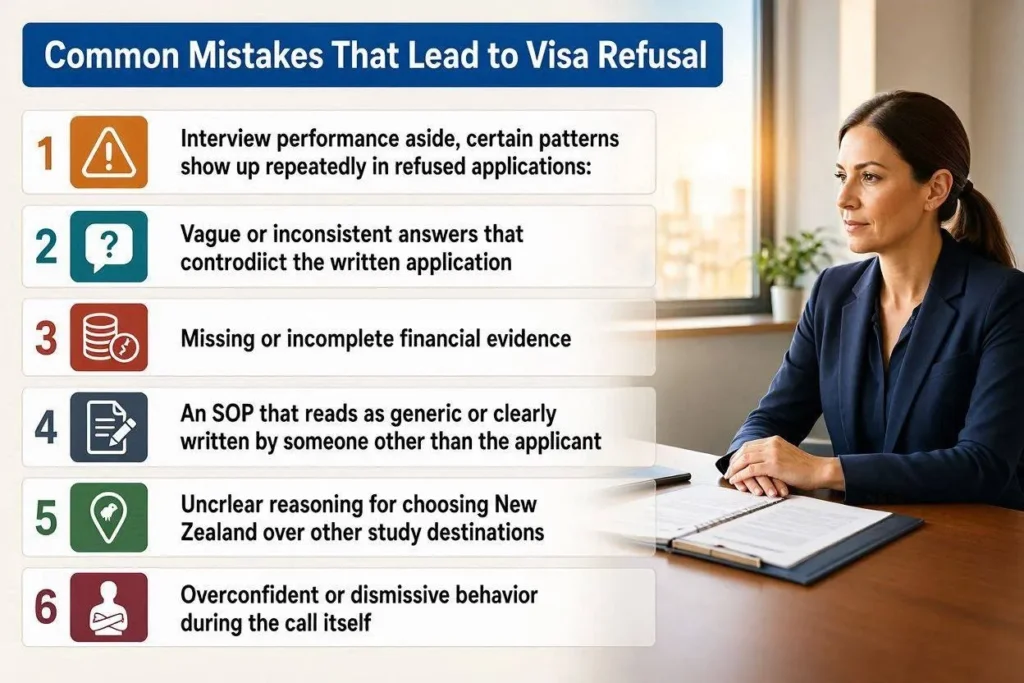
Interview performance aside, certain patterns show up repeatedly in refused applications:
- Vague or inconsistent answers that contradict the written application
- Missing or incomplete financial evidence
- An SOP that reads as generic or clearly written by someone other than the applicant
- Unclear reasoning for choosing New Zealand over other study destinations
- Overconfident or dismissive behavior during the call itself
Avoiding these five patterns improves an applicant’s odds regardless of whether an interview happens at all.
How to Prepare for the Interview
Five habits make the biggest difference in interview outcomes.
Review the full application before the call. An applicant should know every figure and claim in their own documents, since officers frequently cross-check spoken answers against the written SOP and financial statements.
Practice out loud with another person. A friend or family member reading through the question list above and playing the officer’s role builds the kind of verbal fluency that silent, mental rehearsal doesn’t.
Keep the phone reachable during business hours in New Zealand. Since INZ often calls without warning, an applicant should avoid silent mode and check for missed calls from unfamiliar +64 numbers daily during the processing period.
Prepare a quiet space in advance. A distraction-free room removes one variable an applicant can control completely, which matters more once nerves are already a factor.
Inform a Licensed Immigration Adviser immediately after any INZ contact. An adviser can flag red flags in real time and prepare an applicant for a follow-up request, if one comes.
Licensed Immigration Adviser vs. Education Agent
A Licensed Immigration Adviser is a professional registered with New Zealand’s Immigration Advisers Authority (IAA) and legally authorized to give immigration advice, while an education agent typically focuses on course and university placement without that legal authorization. Applicants should verify an adviser’s license status directly through the IAA register before paying for interview preparation services, since only licensed advisers carry accountability for the immigration advice they give. An education agent can still be useful for choosing a course or institution, but immigration-specific questions — visa category eligibility or interview readiness, for example — belong with a licensed adviser.
What Happens After the Interview
Immigration New Zealand issues a decision after the interview within the same processing timeframe as a non-interviewed application, which generally runs several weeks depending on visa category and application volume. The officer doesn’t usually announce a decision during the call itself. Applicants should continue checking their application status through the standard INZ online portal rather than expecting immediate verbal confirmation, and should contact their Licensed Immigration Adviser if no update arrives within the officer’s stated timeframe.
Conclusion
A New Zealand student visa interview comes down to preparation and honesty rather than luck. Applicants who know their own application details, answer with specific personal examples, and stay reachable for an unscheduled call give themselves the best chance of a fast approval. The questions rarely change from year to year — what separates a successful interview from a refused one is the depth and consistency of the answers given.
FAQs

Michael Reynolds
Michael Reynolds leads ImmigrationWin’s immigration, visa, and global mobility content division. He specializes in researching immigration policies, visa requirements, application processes, and international relocation pathways for individuals, families, students, and professionals. With extensive experience analyzing immigration regulations and official government guidance, Michael brings a research-driven approach to complex immigration topics and changing visa policies. He is the primary author of ImmigrationWin’s visa guides, immigration resources, and country-specific content, helping readers better understand their options and make informed decisions about their international journey.
Related Posts