
Portugal Visa Types 2026: Complete Guide to All Categories
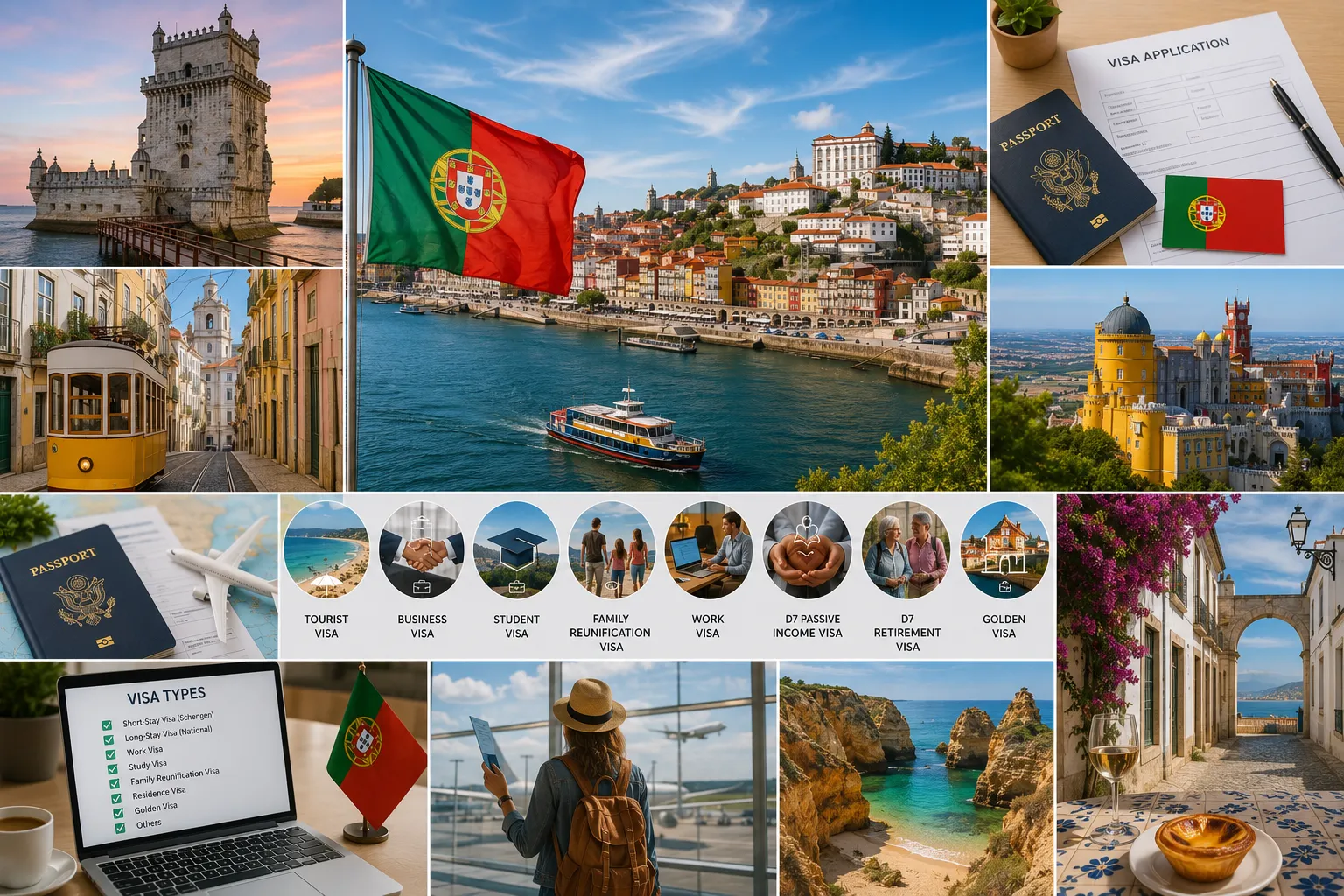
Portugal offers 10 major visa types across 3 categories — short-stay, temporary stay, and long-stay residence — each designed for a specific traveller or resident profile. Choosing the right visa from the available Portugal visa types determines your legal right to work, study, or retire in the country.
As of 2026, the Agência para a Integração, Migrações e Asilo (AIMA) handles all immigration processing in Portugal. AIMA replaced the former SEF (Serviço de Estrangeiros e Fronteiras) agency and now processes every residence permit application. Portugal also introduced the Entry/Exit System (EES), fully operational since April 10, 2026, at all air and sea border points.
Who Needs a Visa to Enter Portugal in 2026?
Whether you need a visa depends on your passport nationality. Portugal sits inside the Schengen Area, so its entry rules apply to all 27 Schengen member states.
EU and EEA Citizens — No Visa Required
EU, EEA, and Swiss citizens enter Portugal without a visa. These citizens can stay indefinitely but must register at a Portuguese address after 90 days. No separate residence permit applies to EU nationals for the first 3 months.
Non-EU Citizens — Visa-Free for 90 Days or Visa Required
Citizens of 62 countries, including the United States, United Kingdom, Canada, and Japan, enter Portugal visa-free for up to 90 days within any 180-day period. After 90 days, these travellers must hold a valid long-stay visa.
All other non-EU nationals require a Schengen visa before travel. You can check Schengen entry rules for your country by reading our guide on Schengen visa rules.
The 3 Main Portugal Visa Categories Explained
Portugal groups its visas into 3 official categories based on intended stay length and purpose.
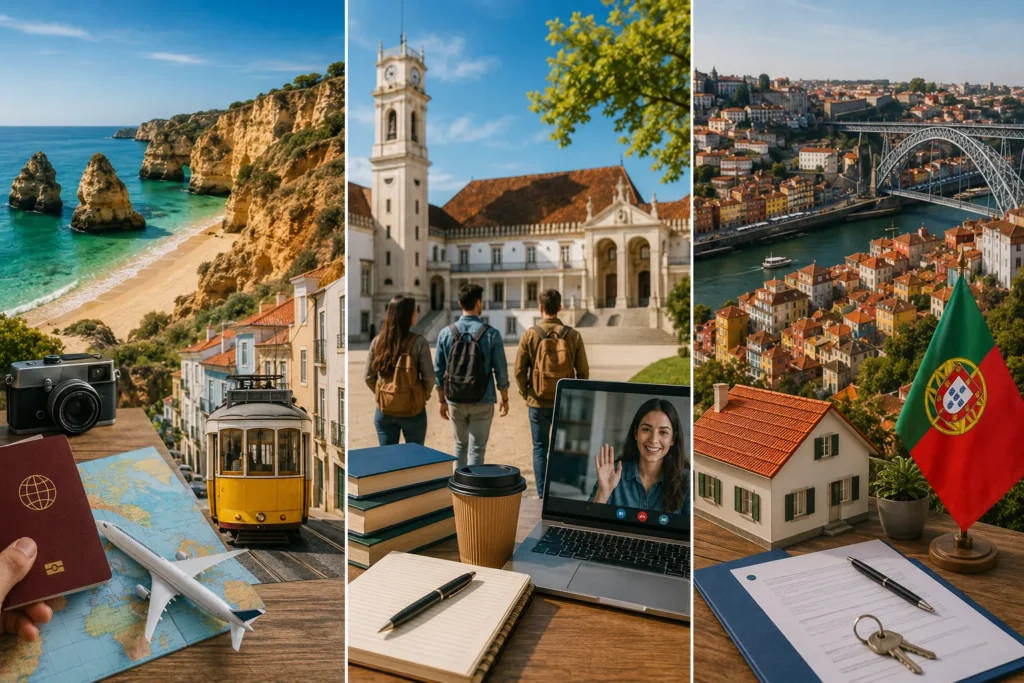
- Schengen short-stay visa (Type C): for stays up to 90 days in any 180-day period — tourism, business, transit.
- Temporary stay visa (Type E): for stays under 1 year — seasonal work, study exchange, unpaid internship, research, amateur sports.
- Long-stay national visa (Type D): for stays over 1 year — employment, passive income, remote work, entrepreneurship, investment, family reunification.
The Type D national visa is the category most applicants target. It grants a 4-month entry window. During those 4 months, you must attend an AIMA biometric appointment and apply for a 2-year residence permit.
Portugal Visa Types Quick-Reference Table
The table below shows every major Portugal visa type, its stay duration, ideal applicant, minimum income or investment, and whether it leads to permanent residency.
| Visa Type | Stay Duration | Who It Suits | Min. Income / Investment | Leads to PR? |
| Schengen (C) | Up to 90 days / 180 | Tourists, business visitors | None | No |
| Job Seeker | 120 days (+60 ext.) | Non-EU job hunters | None (funds required) | No |
| D1 — Employment | Up to 1 year (renewable) | Foreign employees (non-degree) | Work contract | Yes (after 5 yrs) |
| D3 — Highly Qualified | Up to 2 years | Degree-holders, researchers | Work contract + degree | Yes (after 5 yrs) |
| D4 — Student | Duration of study | Non-EU students | University acceptance + funds | No (student) |
| D7 — Passive Income | 2 yrs (renew 3 yrs) | Retirees, passive earners | €920/month | Yes (after 5 yrs) |
| D8 — Digital Nomad | 1 yr (renewable) or 2 yr | Remote workers, freelancers | €3,680/month | Yes (after 5 yrs) |
| D2 — Entrepreneur | 2 yrs (renew 3 yrs) | Non-EU business founders | Business plan + €5,000+ | Yes (after 5 yrs) |
| Golden Visa | 2 yrs (renew 3 yrs) | Non-EU investors | €250,000–€500,000 investment | Yes (after 5 yrs) |
| D6 — Family Reunion | 2 yrs (renew 3 yrs) | Family of Portugal residents | Sponsor must hold permit | Yes (after 5 yrs) |
Portugal Short-Stay Visa Types for Tourists and Visitors
Short-stay visas cover visits lasting up to 90 days. These visas fall under the Schengen Type C category and allow free movement across all 27 Schengen countries, including Germany, France, Spain, and Italy.
Schengen Tourist Visa vs Schengen Business Visa
The Schengen Tourist Visa suits travellers visiting family, sightseeing, or attending cultural events in Portugal. The Schengen Business Visa suits professionals attending meetings, conferences such as the annual Web Summit in Lisbon, or trade visits. Both allow the same 90-day stay within 180 days. Neither permits paid work in Portugal.
To apply for either short-stay visa, submit your application to the Portuguese consulate in your country of residence. Required documents include a valid passport, proof of accommodation in Portugal, travel insurance worth at least €30,000 (approximately $32,700 USD), and bank statements showing sufficient daily funds of at least €75 (approximately $82 USD) per day.
The Job Seeker Visa sits between a short-stay and a long-stay document. It grants 120 days in Portugal and extends by 60 days on request. This visa targets non-EU nationals who want to enter Portugal and find employment before applying for a full residence permit. Portugal is one of only a few EU countries that issues this type of visa.
Portugal Long-Stay Visa Types for Work and Employment
Employment-based long-stay visas fall within the D-series of national visas. Each D-series visa type targets a different worker profile. All lead to a 2-year residence permit and an eventual pathway to permanent residency.
D1 Visa — Standard Employment Visa
The D1 visa suits foreign nationals employed by a Portuguese company who hold no higher education qualification. To qualify, you need a signed employment contract, proof of accommodation in Lisbon, Porto, or another Portuguese city, and a clean criminal record issued within 90 days of application. The employer must also register the job offer with Portugal’s Instituto do Emprego e Formação Profissional (IEFP) to confirm no qualified local worker is available.
D3 Visa — Highly Qualified Activity Visa
The D3 visa targets foreign workers who hold a bachelor’s degree or higher (ISCED Level 6+) or professionals in scientific research, academic teaching, or senior corporate roles. Unlike the D1 visa, D3 applicants receive priority processing at AIMA upon arrival in Portugal. D3 holders also qualify for the IFICI regime (also known as NHR 2.0), which can reduce the effective Portuguese tax rate on qualifying foreign income for up to 10 years.
Workers in highly technical fields, such as software engineers, biotech researchers, and university lecturers, typically apply through the D3 route. If you are considering employment-based residency in one of the long-stay visa categories available across top destinations, Portugal’s D3 remains one of Europe’s most accessible skilled worker pathways.
Portugal Residence Visa Types for Long-Term Stays
Residence visas form the core of the Portugal visa system for people planning to live in the country permanently. The 3 most popular residence visas in 2026 are the D7, D8, and D2. Each targets a different income source and lifestyle.
D7 Passive Income Visa — Requirements in 2026
The D7 visa suits retirees, landlords, dividend earners, and anyone with stable monthly passive income of at least €920 (approximately $1,000 USD at 2026 rates). Accepted income sources include pensions, rental income, dividends, royalties, and investment returns.
To apply for the D7 visa, you must open a Portuguese bank account, obtain a Portuguese Tax Identification Number (NIF), and provide 3 months of bank statements. The D7 visa fee is €90 per applicant. After arriving in Portugal on your D7 visa, you attend an AIMA appointment to collect a 2-year residence permit card. The total processing timeline averages 9 months from initial preparation to receiving your permit card.
D7 holders must reside in Portugal for at least 16 months out of every 2-year permit period. Absences of more than 6 consecutive months cancel the permit. After 5 years of continuous legal residence, D7 holders can apply for permanent residency or Portuguese citizenship.
Portugal approved a nationality law change in May 2026 that extended the general citizenship eligibility period from 5 to 10 years. Citizens of Community of Portuguese Language Countries (CPLP) — including Brazil, Angola, Mozambique, and Cape Verde — remain eligible after 7 years. The 5-year permanent residency pathway remains unchanged.
D8 Digital Nomad Visa — Income Threshold for 2026
The D8 visa is Portugal’s official Digital Nomad Visa, introduced in October 2022. It targets remote workers, freelancers, and independent contractors who earn income from employers or clients based outside Portugal.
The minimum monthly income requirement for the D8 visa in 2026 is €3,680 per month (4 × the Portuguese minimum wage of €920). For a spouse added to the application, the threshold rises by 50% to €5,520 per month. Each additional dependent child adds 30% to the base requirement.
The D8 visa has 2 streams. The Temporary Stay stream grants 1 year in Portugal with renewal options. The Residence stream grants a 4-month entry visa, followed by a 2-year AIMA residence permit. The Residence stream leads to permanent residency and citizenship after 5 years of genuine physical presence. D8 holders cannot absent themselves from Portugal for more than 6 consecutive months or 8 non-consecutive months within any 2-year permit period.
D8 holders who spend more than 183 days per year in Portugal become Portuguese tax residents. These holders may qualify for the IFICI regime (NHR 2.0), which offers reduced tax rates on qualifying foreign-sourced income for up to 10 years.
D2 Entrepreneur Visa and Startup Visa
The D2 visa suits non-EU entrepreneurs who want to start a business, relocate an existing company, or work as independent professionals in Portugal. Unlike the D7 or D8 visas, the D2 visa requires no minimum income threshold. Instead, you must present a viable business plan showing economic benefit to Portugal, proof of incorporation or intent to incorporate a Portuguese company, and at least €5,000 in startup capital held in a Portuguese bank account.
The Portugal Startup Visa is a separate programme for high-growth, technology-focused companies. Startup Visa applicants must enroll with a licensed incubator certified by IAPMEI (the Portuguese Agency for Competitiveness and Innovation) and present an innovative product or service. The Startup Visa requires a bank statement showing at least €6,200 in available funds. No minimum investment applies.
Portugal Golden Visa 2026 — Investment-Based Residency

The Portugal Golden Visa grants residency to non-EU nationals who make a qualifying investment in Portugal’s economy. Real estate purchases no longer qualify as of 2023. The 2 main investment routes in 2026 are:
- €250,000 donation to cultural heritage restoration, arts support, or scientific research projects.
- €500,000 investment in qualifying Portuguese investment funds or research activities approved by CMVM (the Portuguese Securities Market Commission).
Golden Visa holders need to spend only 7 days per year in Portugal to maintain their residency status. This minimal stay requirement makes the Golden Visa the only Portugal visa type that allows holders to keep their primary residence in another country. Spouses, dependent children under 26, and dependent parents can all join the main applicant’s application at no additional investment cost.
After 5 years, Golden Visa holders can apply for permanent residency or Portuguese citizenship — subject to an A2-level Portuguese language test and proof of integration. Golden Visa holders apply directly to AIMA. Current AIMA processing times range from 30 to 90 days at the consulate stage and 1 to 6 months for biometric appointments in Portugal. For a comparison with investment residency programs in other popular destinations, check our country-by-country breakdown.
Portugal Family and Student Visa Types
Portugal also issues 2 dedicated visa types for family members and international students: the D6 Family Reunification Visa and the D4 Student Visa.
D6 Family Reunification Visa
The D6 visa allows the family members of a legal Portugal resident to live in Portugal. The main applicant must already hold a valid Portuguese residence permit before sponsoring family members. Under Portugal’s Lei n.º 61/2025, introduced in 2025, most sponsors must now complete 2 years of residence before the family reunification application can proceed.
The following family members qualify for a D6 visa: spouses or legally recognised partners; dependent children under 18 (including adopted children); unmarried adult children over 18 who are enrolled in a Portuguese educational institution; first-degree direct ascendants (parents) who are financially dependent on the main applicant; and minor siblings who are financially dependent on the main applicant.
D4 Student and Study Visa
The D4 visa targets non-EU students accepted by a Portuguese university or accredited educational institution. This visa also covers student exchange programmes, unpaid professional internships, volunteer work, and language training programmes. The D4 visa duration matches the enrolled study programme length. D4 holders can work up to 20 hours per week in Portugal without a separate work permit.
Required documents for the D4 visa include a university acceptance letter, proof of tuition fee payment, proof of accommodation in Portugal, travel insurance, and evidence of sufficient funds. The Portuguese minimum monthly reference amount for student support stands at €920 in 2026.
How to Apply for a Portugal Visa in 2026
To apply for any Portugal long-stay visa, follow these 4 steps.
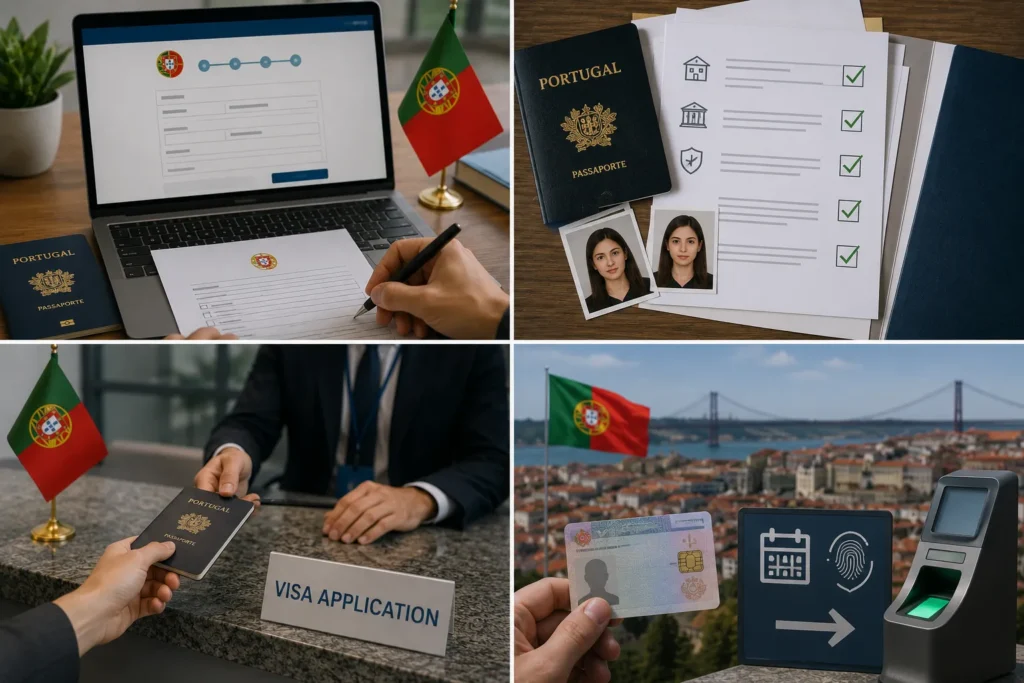
- Complete the national visa application form available on the vistos.mne.gov.pt portal or at your nearest Portuguese consulate.
- Collect all supporting documents — passport valid for at least 3 months beyond your planned return date, 2 passport photos, police clearance certificate issued within 90 days, proof of accommodation, proof of funds, health insurance, and any visa-specific documents such as a work contract, bank statements, or business plan.
- Submit your application at the Portuguese consulate or through VFS Global in your country of residence. Pay the visa fee (€90 for a national D-visa) and the VFS service fee of approximately $43.91 USD (approximately €40).
- After consulate approval, enter Portugal within the 4-month visa window and book your AIMA biometric appointment online through the AIMA platform. AIMA appointment wait times in Lisbon and Porto currently run from 1 to 6 months due to a backlog exceeding 400,000 pending cases.
AIMA confirmed in 2025 that residence permits expired on or before June 30, 2025, remain valid for 6 months from October 15, 2025 — or for 6 months from the card’s expiry date if the card expired after June 30, 2025. This grace period prevents legal gaps while AIMA clears its backlog.
Conclusion
Portugal’s 10 visa types cover every lifestyle and professional profile — from retirees drawing a pension to remote workers, investors, entrepreneurs, students, and families.
The right visa for you depends on your income source, intended stay length, and long-term residency goals. Selecting the wrong visa type can result in rejection or AIMA delays.
FAQs

Michael Reynolds
Michael Reynolds leads immigration content at ImmigrationWin, covering visa requirements, application and relocation pathways. He researches immigration policies and official government guidance to explain changing rules clearly. His guides help students, families, and professionals make informed decisions about moving abroad.
Related Posts