
Italy Visa Types 2026: Complete Guide for Every Stay
Italy offers 8 main visa types in 2026: the Type C Schengen short-stay visa, the Type D national long-stay visa, the work visa (subordinate employment), the student visa, the digital nomad visa, the elective residence visa, the investor golden visa, and the family reunification visa. Your correct visa type depends on your purpose, intended length of stay, and whether you plan to work in Italy.
Non-EU nationals who hold passports from visa-exempt countries — including the United States, Canada, the United Kingdom, and Australia — enter Italy visa-free for stays up to 90 days. All other nationalities, and anyone staying beyond 90 days for any reason, must hold a valid Italy visa types category that matches their purpose.
Italy Visa Types: The 2 Broad Categories You Must Know First
Italian visas divide into 2 categories: the Type C short-stay Schengen visa (valid up to 90 days) and the Type D national long-stay visa (valid beyond 90 days). Every specific visa in Italy falls under one of these 2 categories.
Type C Short-Stay Schengen Visa
The Type C visa permits a stay of up to 90 days within any rolling 180-day period across all 29 Schengen Area countries, including Italy. Nationals who require a Schengen visa — such as citizens of Pakistan, India, Bangladesh, Nigeria, and Egypt — apply for a Type C visa at the Italian consulate in their country of residence. Permitted activities include tourism, business meetings, short courses under 90 days, and family visits. The standard fee is €80 for adults and €40 for children aged 6 to 12. Children under 6 pay no fee.
Processing takes 10 to 15 business days outside peak season (June to August) and up to 30 to 60 days during summer. Apply at least 6 weeks before your planned travel date. For a detailed breakdown of how Type C compares to Type A and Type D across the full Schengen zone, read the Schengen visa types guide.
Type D National Long-Stay Visa
The Type D national visa covers all stays beyond 90 days in Italy. The Type D visa governs 6 major subcategories: work (subordinate employment), student, digital nomad, elective residence, investor (golden visa), and family reunification. Each subcategory requires distinct documents and meets separate eligibility thresholds. After you enter Italy on a Type D visa, you must apply for a Permesso di Soggiorno (residence permit) at your local Questura (provincial police headquarters) within 8 working days of arrival.
Italy Visa Types 2026: Quick-Reference Table
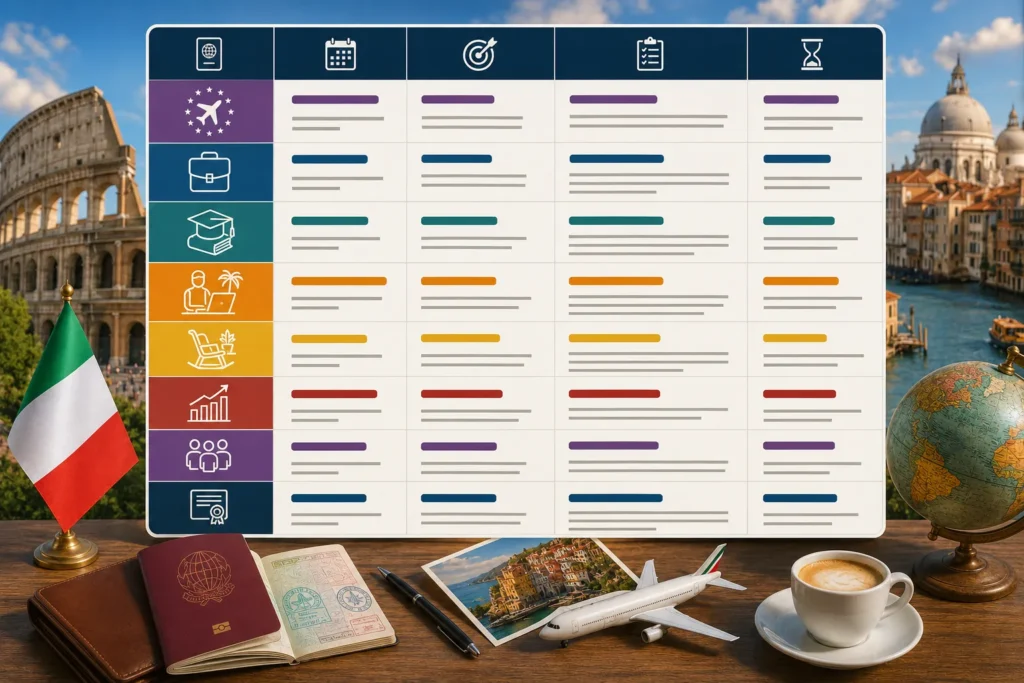
| Visa Type | Max. Stay | Main Purpose | Key Requirement | Processing Time |
| Type C (Schengen) | 90 days / 180-day period | Tourism, short business, family visit | €80 fee, travel insurance €30,000 min | 10–15 business days |
| Work Visa (Subordinate) | 1–2 years, renewable | Employed by Italian company | Nulla Osta from employer; Decreto Flussi quota | 2–6 weeks (permit) + 2–4 weeks (visa) |
| Student Visa | Duration of program | Degree or 90+ day language course | Acceptance letter, €448/month proof of funds | 15–30 days |
| Digital Nomad Visa | 1 year, renewable | Remote work for foreign employer/clients | €28,000/year income, 6+ months experience | 30–90 days |
| Elective Residence Visa | 1 year, renewable | Retire or live in Italy without working | €31,000+/year passive income | 15–30 days |
| Investor Golden Visa | 2 years, renewable | Residency by qualifying investment | €250,000 startup to €2M gov bonds | 3–6 months total |
| Family Reunification | Duration of sponsor’s permit | Join legally resident family member | Sponsor’s valid permesso di soggiorno | 30–60 days |
| EU Blue Card | 2 years, renewable | Highly skilled professional employment | University degree, salary ≥ threshold | 4–8 weeks |
Italy Work Visa Types: Subordinate Employment and the EU Blue Card
Italy issues 3 main work visa types: the subordinate employment visa, the self-employment visa, and the EU Blue Card. Each requires a separate application process and distinct documentation.
How to Get the Italy Subordinate Employment Visa
To get the Italy subordinate employment visa, your Italian employer applies for a Nulla Osta al Lavoro (work authorization) at the provincial Sportello Unico per l’Immigrazione (S.U.I. — Single Immigration Desk). The Nulla Osta is only available during open windows under the Decreto Flussi (flow decree) — Italy’s annual quota system that sets limits on non-EU workers. In 2025, the government issued 165,000 quota slots across seasonal and non-seasonal categories.
After your employer receives the Nulla Osta, you apply for the work visa at the Italian consulate in your country of residence. The combined process takes 1 to 3 months. The visa is employer-specific: changing employers requires a new Nulla Osta and a new quota slot.
EU Blue Card Italy: Requirements for Highly Skilled Workers
The EU Blue Card targets highly qualified professionals with a university degree or equivalent qualification and a job offer from an Italian employer. The employment contract must offer a gross annual salary of at least 1.5 times the average gross national salary in Italy. The Blue Card gives a 2-year renewable residence permit and provides a faster path to EU long-term residency. Unlike the standard work visa, the Blue Card applicant does not need to wait for Decreto Flussi quota windows — it falls outside the standard quota system.
Italy Student Visa: How to Study in Italy for More Than 90 Days
To study in Italy for more than 90 days, you need a Type D student visa, also called a Visto per Studio. EU/EEA citizens are exempt. Non-EU students enrolling in university degree programs (Bachelor’s, Master’s, or PhD) or language courses lasting more than 90 days must apply for this visa before departure.
Documents required include: a university acceptance letter through the Universitaly portal, proof of funds of at least €448 per month (or €6,079.45 per academic year as a minimum bank balance), accommodation confirmation, health insurance, and a completed visa application form with 2 recent photos measuring 35mm x 45mm (approximately 1.4 inches x 1.8 inches). The student visa fee is approximately €50.
Students on a Type D student visa can work part-time for up to 20 hours per week. After graduation, students convert the student visa into an employment permit if they secure a job offer — a direct pathway Italy specifically provides for university graduates.
Italy Digital Nomad Visa vs. Elective Residence Visa: Key Differences in 2026
These 2 visa types are frequently confused because both allow long-term residence in Italy without local Italian employment. The digital nomad visa requires active remote work; the elective residence visa requires passive income only. Choosing the wrong category results in a visa refusal.
Italy Digital Nomad Visa Requirements for Remote Workers
The Italy Digital Nomad Visa — formally the Visto per Nomadi Digitali — launched in April 2024 under Decree Law 4/2022. The visa targets non-EU highly skilled remote workers and freelancers who earn income from employers or clients based outside Italy. Requirements include: a minimum annual income of €28,000, at least 6 months of documented remote work experience, a university degree or equivalent professional qualification, a signed lease (temporary hotel stays are not accepted), and health insurance with at least €30,000 coverage.
The digital nomad visa is issued for 1 year and is renewable annually. It sits outside Italy’s immigration quota system — there are no Decreto Flussi limits on digital nomad applications. After 5 continuous years of legal residence, you qualify for EU long-term residency. After 10 years, you qualify for Italian citizenship by naturalization. The application fee is €116 and processing takes 30 to 90 days depending on the consulate.
Italy Elective Residence Visa: For Retirees and Passive Income Holders
The elective residence visa suits non-EU nationals who want to live in Italy without working — typically retirees, pensioners, and individuals living off investments or rental income. The income threshold is €31,000 per year minimum from passive sources such as pensions, savings interest, or property rental. Work of any kind, including remote work, is not permitted on this visa.
If you hold a pension, savings, or investment income but no active employment, the elective residence visa provides more stability with fewer employment document requirements than the digital nomad visa. Both visas lead to the same Permesso di Soggiorno process on arrival and both require a registered lease, not a hotel booking.
Italy Investor Golden Visa: Residency Through Qualifying Investment

The Italy Investor Visa — commonly called the Italy Golden Visa — grants a 2-year initial residence permit to non-EU nationals who make a qualifying investment. Italy accepts 4 investment routes: a minimum of €250,000 in an innovative Italian startup, €500,000 in an Italian limited company, €2 million in Italian government bonds, or a €1 million philanthropic donation to a cultural or scientific project.
The application follows a 2-step process: first, submit an investment plan to the Investor Visa for Italy Committee for a Nulla Osta (certificate of no impediment); second, apply for the entry visa at the Italian consulate in your country. The total timeline from document submission to residence permit issuance is 3 to 6 months. The golden visa leads to permanent residency after 5 years and citizenship eligibility after 10 years of continuous legal residence.
For a broader comparison of golden visa programs across Europe and the Middle East, the golden visa guide on ImmigrationWin covers investment thresholds, timelines, and tax implications across the top 10 programs available in 2026.
Italy Family Reunification Visa: How to Bring Family to Italy
To bring family members to Italy, a non-EU national with a valid Italian residence permit (permesso di soggiorno) sponsors a Family Reunification Visa application. Eligible family members include spouses, dependent children under 18, and dependent parents over 65 with no other family support in their home country.
The sponsor must prove: a valid permesso di soggiorno with at least 1 year of remaining validity, a minimum annual income of €8,500.01 (plus €2,840 for each additional family member), and adequate accommodation that meets Italian housing standards. The family member then applies for the visa at the Italian consulate in their country of residence. Processing typically takes 30 to 60 days.
Once in Italy, the family member applies for their own residence permit within 8 working days at the local Questura. The family reunification permit carries the same validity period as the sponsor’s permit.
2026 Changes That Affect All Italy Visa Types
3 major changes in 2026 affect applicants across all Italy visa types categories.
EU Entry/Exit System (EES) Now Fully Operational
The Entry/Exit System (EES) became fully operational across all Schengen external borders on 10 April 2026. EES records fingerprints, facial images, and passport data for all third-country nationals at every Schengen border crossing, including all Italian airports and land borders. The EES replaces manual passport stamping and automatically tracks each traveller’s 90/180-day Schengen days. Overstays are now detected automatically and stored in the Schengen Information System (SIS), affecting future visa applications across all 29 Schengen states.
ETIAS Launches for Visa-Exempt Travelers in Late 2026
The European Travel Information and Authorisation System (ETIAS) is scheduled to launch in the last quarter of 2026. ETIAS applies to nationals of approximately 60 visa-exempt countries — including the United States, United Kingdom, Canada, and Australia — who currently enter Italy without a visa. ETIAS is an online pre-screening authorization, not a visa. The fee is €20, free for applicants under 18 and over 70. The authorization is valid for 3 years or until passport expiry. Nationals who need a Schengen Type C visa continue to apply through Italian consulates as before — ETIAS does not replace their visa requirement.
For context on how Italy’s visa structure fits within the broader Schengen framework, the Australian visa types guide provides a useful parallel for understanding how points-based and category-based visa systems compare across different immigration architectures.
How to Apply for Italy Visa Types: The 6-Step Process
To apply for any Italy visa type, follow these 6 steps in sequence.
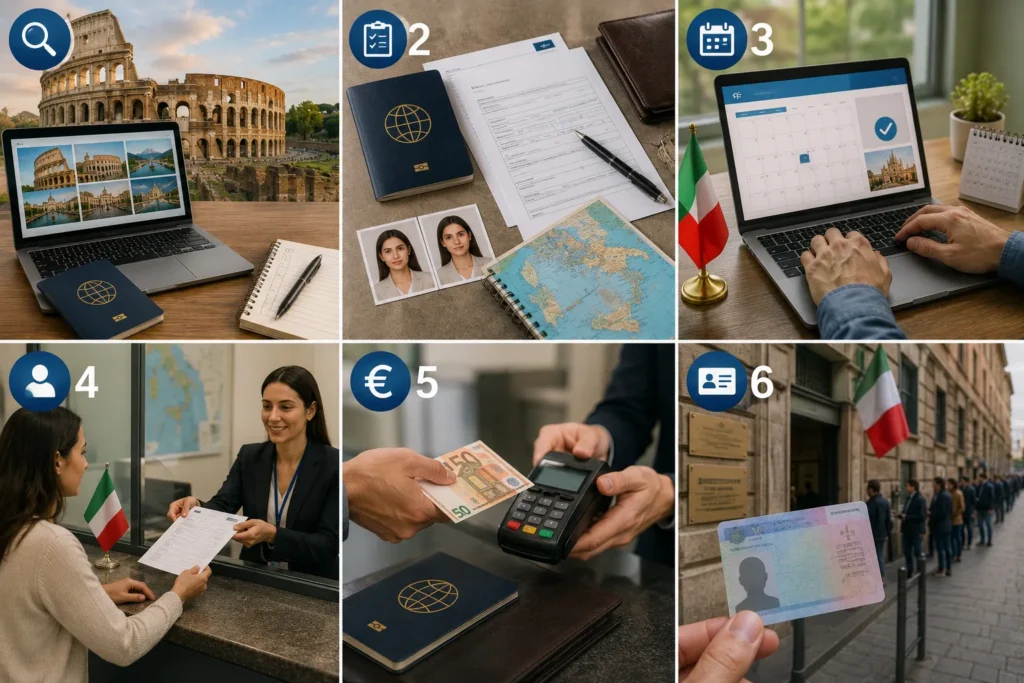
- Step 1 — Identify your visa category: Match your purpose (tourism, work, study, remote work, retirement, investment, or family) to the correct visa type using the table above.
- Step 2 — Gather your documents: Every category requires a valid passport (at least 15 months validity for a Type D visa), 2 photos sized 40mm x 35mm (approximately 1.6 inches x 1.4 inches), proof of funds, accommodation proof, and travel/health insurance. Long-stay visas require category-specific documents such as the Nulla Osta for work visas or the acceptance letter for student visas.
- Step 3 — Book your appointment: Schedule at the Italian consulate in your country of residence or at an authorized center such as VFS Global. Book 3 to 4 weeks in advance for summer applications (June to August) when queues are longest.
- Step 4 — Attend your appointment: Submit all original documents plus full photocopies. All documents in non-Italian languages require certified translation into Italian or English.
- Step 5 — Pay the visa fee: Type C: €80 (adults), €40 (children 6–12). Type D: €116 for most long-stay national visa categories.
- Step 6 — Apply for permesso di soggiorno: Within 8 working days of arriving in Italy on any Type D visa, go to your local Questura or Poste Italiane office to apply for your Permesso di Soggiorno (residence permit). Failure to do this within 8 working days violates Italian immigration law.
Conclusion
Italy’s visa system in 2026 covers 8 distinct categories for every type of applicant — from a 90-day tourist visiting Rome to a digital nomad setting up in Florence or an investor securing residency through a €250,000 startup stake. Each category carries specific income thresholds, document requirements, and processing timelines. Submitting the wrong category, missing a document, or misreading the Decreto Flussi quota window results in refusal and months of delays.
ImmigrationWin’s certified consultants assess your profile against every Italy visa types category, prepare a complete error-free application package, and monitor every step from document submission to Permesso di Soggiorno issuance.
Frequently Asked Questions

Michael Reynolds
Michael Reynolds leads immigration content at ImmigrationWin, covering visa requirements, application and relocation pathways. He researches immigration policies and official government guidance to explain changing rules clearly. His guides help students, families, and professionals make informed decisions about moving abroad.
Related Posts