
France Visa Types: Complete 2026 Guide for Every Purpose
France recognises 3 main France visa type categories: the short-stay Schengen visa (Type C), the long-stay national visa (Type D), and the airport transit visa (Type A). Your correct France visa type depends on your nationality, the purpose of your visit, and how long you plan to stay.
France issued 2.86 million visas in 2024, a 16.8% increase from the previous year. Whether you travel for tourism, study, work, or family reunification, each France visa type follows separate rules, fees, and documentation requirements. This guide covers every category active in 2026.
France Visa Types by Duration: Short-Stay vs Long-Stay
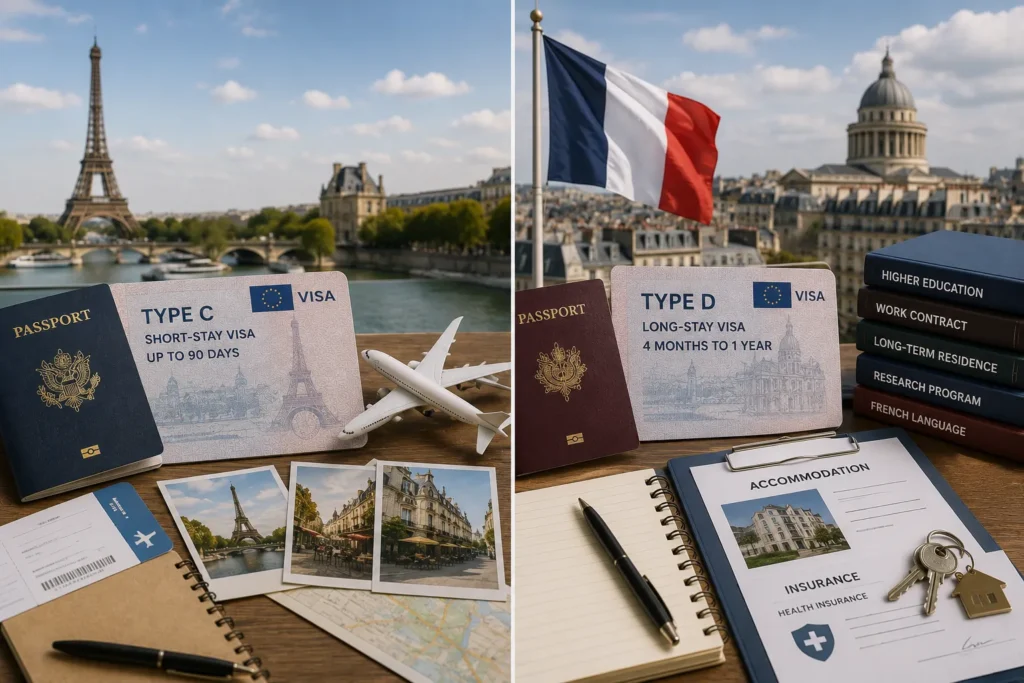
France divides visas into 2 duration categories. Short-stay visas cover stays up to 90 days. Long-stay visas cover stays from 4 months to 1 year, with the option to renew.
Short-Stay Visa (Type C) — Up to 90 Days
The Type C Short-Stay visa allows stays of up to 90 days in any 180-day period. It covers tourism, business trips, short family visits, cultural events, and medical treatment. As a Schengen Area member, France issues a uniform Schengen visa that lets you travel across all 29 Schengen member states on a single visa. The visa fee is €80 for adults and €40 for children aged 6 to 12. Children under 6 pay no fee. Processing typically takes 15 calendar days from the date of application.
You cannot extend a short-stay Type C visa inside France. You must exit the Schengen Area and reapply at a French consulate in your country of residence. Your passport must be valid for at least 3 months beyond your planned departure from the Schengen Area.
Long-Stay Visa (Type D) — 4 Months to 1 Year
The Type D long-stay visa covers stays of 4 months to 1 year. French consulates issue Type D visas in 2 forms. The VLS-TS (visa long séjour valant titre de séjour) acts as a residence permit — you validate it on the ANEF (Administration Numérique des Étrangers en France) portal within 3 months of arrival. The second form requires you to visit your local prefecture within 2 months to collect a residence card (carte de séjour). The Type D visa fee is €99 for most categories. Before this visa expires, you apply for a carte de séjour renewal to continue living in France legally.
France Visa Types by Purpose: All 6 Categories Explained
French immigration law groups France visa types into 6 purpose-based categories: tourist and private stay, professional, student, family, transit, and special categories. Each category carries distinct requirements and rights.
Quick-Reference Table: France Visa Types at a Glance
| Visa Category | Type | Duration | Fee (Adult) | Processing | Work Allowed? |
|---|---|---|---|---|---|
| Tourist / Private | Type C | Up to 90 days | €80 | 15 days | No |
| Student (Short) | Type C | Up to 90 days | €80 | 15 days | No |
| Student (Long) VLS-TS | Type D | 4–12 months | €99 | 15–30 days | Up to 60 hrs/month |
| Work / Employee | Type D | 4–12 months | €99 | 15–30 days | Yes (contract only) |
| Talent Passport | Type D | 4–12 months | €99 | 15–30 days | Yes |
| Family Long-Stay | Type D | 4–12 months | €99 | 15–30 days | Depends on category |
| Visitor (No Work) | Type D | Up to 12 months | €99 | 15–30 days | No |
| Airport Transit | Type A | 24 hours max | €80 | 15 days | No |
1. Tourist and Private Stay Visa
The French tourist visa is a Type C Schengen visa valid for stays up to 90 days. You apply for this France visa type to sightsee, visit Paris, attend cultural events like the Festival d’Avignon, or recover from a medical procedure. The visa carries a work restriction — you cannot take up paid employment on it.
Required documents include a valid passport, travel insurance with a minimum €30,000 coverage, proof of accommodation (hotel bookings or a host’s attestation d’accueil), return ticket, and bank statements showing financial means. France allows single-entry, double-entry, and multiple-entry tourist visas. A multiple-entry visa valid for 5 years is available to frequent travellers who have legally used 3 prior uniform Schengen visas in the last 2 years.
Travellers planning to stay beyond 90 days without working apply for the long-stay visitor visa (VLS-TS visiteur). Applicants must prove financial self-sufficiency of at least €1,426 per month (the French minimum wage as of November 2024), private health insurance covering a minimum of €30,000, and French accommodation. This route serves retirees and financially independent individuals. France has no separate retirement visa; retirees apply under the visitor category.
For a detailed breakdown of how Schengen rules apply across all 29 member states, read the full Schengen visa types guide before you book your trip.
2. France Work Visa Types
France offers 5 main work-related France visa types: the salaried employee visa, the temporary worker visa, the talent passport, the intra-company transferee visa, and the self-employed professional visa.
Salaried Employee Visa (Salarié): For foreign nationals with a French employment contract lasting at least 12 months. The employer must obtain work authorisation from the DREETS (Direction Régionale de l’Économie, de l’Emploi, du Travail et des Solidarités) before the visa application. The visa allows the holder to enter France and apply for a multi-year residence card.
Temporary Worker Visa (Travailleur Temporaire): For fixed-term contracts lasting less than 12 months. This France visa type covers seasonal workers, short-term assignments, and secondments.
Talent Passport (Passeport Talent / Carte de Séjour Pluriannuelle «Talent»): For highly qualified professionals, researchers, company founders, investors, artists, and doctoral students. Following France’s 2025 immigration reform, the pre-approval process for this France visa type now involves stricter checks. A talent passport holder may receive a multi-year residence card directly on arrival, bypassing the standard annual renewal cycle.
Self-Employed / Liberal Professional Visa: For entrepreneurs and independent professionals who register a business in France. Applicants must demonstrate economic viability and sufficient personal funds to cover their first months of operation.
Intra-Company Transferee Visa: For employees seconded to a French branch of a multinational. The French salary must be at least 1.8 times the French minimum wage (€38,918 per year as of November 2024). No labour market test applies under this category.
3. France Student Visa Types
France offers 3 student France visa types: the short-stay student visa, the long-stay student VLS-TS, and the internship visa.
Short-Stay Student Visa: For programmes or entrance exams lasting up to 90 days. The étudiant-concours variant applies if you travel to sit a French institution entrance exam.
Long-Stay Student Visa (VLS-TS Étudiant): For bachelor’s and master’s programmes lasting more than 90 days. The visa is valid for 4 to 12 months and doubles as a residence permit. You validate the VLS-TS Étudiant on the ANEF portal within 3 months of arriving in France. Students at doctoral level and above apply for the Talent Passport VLS-TS instead. After the first year, eligible students apply for a multi-year student residence card (carte de séjour pluriannuelle étudiant) valid for up to 4 years.
Internship Visa (Stagiaire Étudiant): For students completing a placement in France as part of their home-country curriculum. Internships under 90 days receive a Type C visa. Internships over 90 days receive a VLS-TS that requires ANEF validation on arrival.
Nationals from 68 countries must complete a Campus France pre-enrollment before applying for a student visa. The Campus France procedure starts online at campusfrance.org. Students must show at least €615 per month in available funds, a confirmed university place, and health insurance for the full duration of the programme.
If you are comparing long-stay student options across multiple countries, the Australian visa types guide covers the Subclass 500 student visa as a useful point of comparison.
4. France Family Visa Types
France issues 4 family-related France visa types: the short-stay family visit visa, the long-stay spouse visa, the family reunification visa, and the accompanying-family (Talent Famille) visa.
Spouse of a French National (Conjoint de Français): The foreign spouse applies for a long-stay visa, then a vie privée et familiale residence card at the local prefecture. A marriage conducted abroad must be transcribed into French civil-status records before the visa application.
Family Reunification (Regroupement Familial): A non-EU resident in France can bring their spouse and minor children after at least 18 months of lawful residence. The sponsor must hold an eligible residence permit, have suitable housing in France, and show sufficient income.
Talent Famille: Family members of Talent Passport holders use a simplified accompanying-family route instead of standard family reunification. The Talent Famille visa grants the holder a residence card that also authorises work in France.
PACS Partner (Partenaire lié par un PACS): A foreign national in a registered French civil partnership (Pacte Civil de Solidarité) applies for a long-stay visa under the vie privée et familiale category. The applicant must prove a genuine and stable relationship and provide joint-life evidence.
France Airport Transit Visa (Type A): Who Needs It in 2026
The Airport Transit Visa (ATV) is required by nationals of certain countries who connect through French airports, such as Paris Charles de Gaulle (CDG) or Paris Orly, without entering the Schengen Area. The ATV covers stays in the international transit zone only, for a maximum of 24 hours. France maintains its own national ATV list in addition to the EU-wide common list. Nationals of 12 countries — including Afghanistan, Bangladesh, Ghana, Iran, Iraq, Nigeria, Pakistan, and Sri Lanka — require an ATV for any Schengen airport.
ATV exemptions apply automatically to holders of a valid Schengen visa, a US, Canadian, UK, or Japanese visa, or a residence permit from the EU, UK, Canada, or Japan. The ATV fee matches the standard Schengen rate of €80 for adults. Apply at the French consulate in your country at least 15 days before departure.
How to Apply for a France Visa Types: Step-by-Step Process
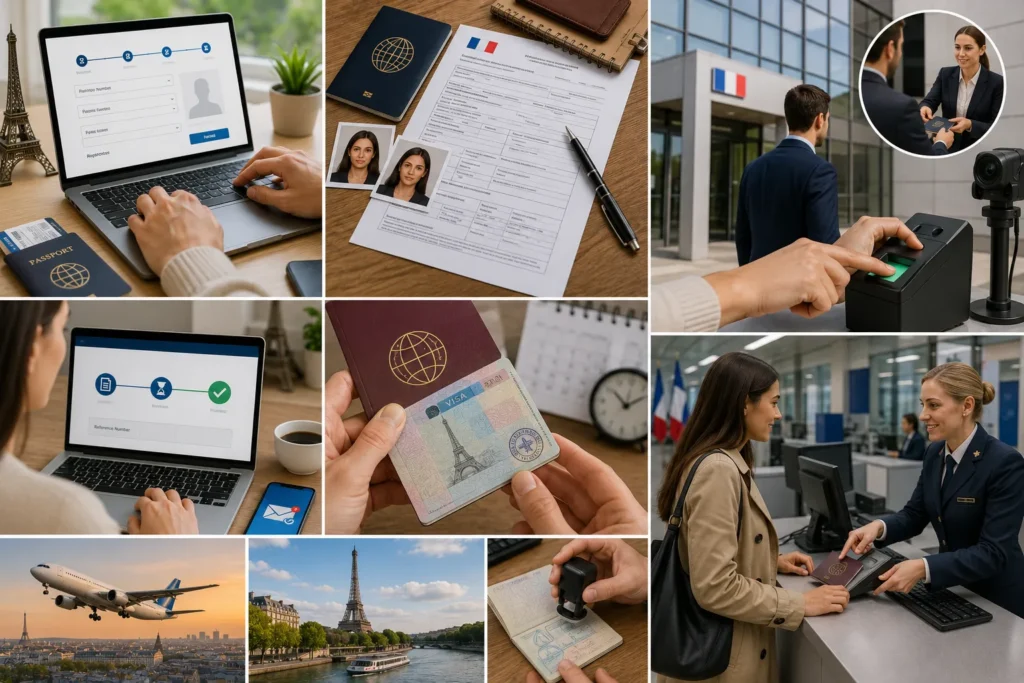
To apply for any France visa tpe, follow these 5 steps:
Step 1: Confirm Your France Visa Type on France-Visas
To confirm your correct France visa type, use the Visa Wizard on the France-Visas portal (france-visas.gouv.fr). Enter your nationality, destination, purpose, and intended duration. The wizard returns the exact visa category, required documents, and the applicable fee. Apply no more than 3 months before your planned entry date.
Step 2: Gather Your Documents by Category
To gather documents correctly, collect the following for all France visa types: a valid passport (minimum 3-month validity beyond your stay), 2 passport photos, the completed CERFA visa form with printed receipt, proof of accommodation, travel health insurance (minimum €30,000 coverage), and proof of financial means. Long-stay visas require additional category-specific documents such as employment contracts, university enrollment letters, or family certificates.
Step 3: Book an Appointment and Submit Your Application
To submit your application, book an appointment at the French consulate or an authorised visa application centre (such as VFS Global or TLS Contact) in your country of residence. Attend the appointment with your printed CERFA, supporting documents, and the visa fee. Biometric data — fingerprints and a digital photograph — is collected at this stage. Pay the non-refundable visa fee at the time of submission.
Step 4: Wait for Processing and Collect Your Passport
Standard processing for a short-stay visa is 15 calendar days. Long-stay visa processing ranges from 15 to 30 days depending on category and season. Track your application through the France-Visas portal using your application reference number. Do not purchase non-refundable travel tickets before you receive your passport.
Step 5: Validate Your Visa After Arrival in France
To validate a VLS-TS long-stay visa, log into the ANEF portal within 3 months of arrival. Pay the OFII (Office Français de l’Immigration et de l’Intégration) tax, which varies by visa category. Validation activates your right to reside legally in France and cross Schengen borders. Holders of certain long-stay visas must also sign the CIR (Contrat d’Intégration Républicaine) with OFII, which includes a French language assessment and civic training session. From 2026, applicants seeking multi-year residence cards must pass a civic exam on French republican values.
Key 2026 Changes That Affect France Visa Types
3 developments in 2025 and 2026 directly affect France visa types. First, the Entry/Exit System (EES) launched on October 12, 2025. EES records biometric data and precise entry/exit timestamps for all third-country nationals at every external Schengen border. Overstays are now detected automatically and appear in the Schengen Information System (SIS), affecting future applications across all 29 Schengen states.
Second, France’s 2025 immigration reform (Loi No. 2024-42 of 26 January 2024) tightened the pre-approval requirements for Talent Passport applicants and clarified remote work restrictions. Self-employed visa holders may not perform remote work for foreign clients without specific authorisation under French law. Third, from 2026, applicants seeking a multi-year carte de séjour pluriannuelle must demonstrate a minimum French language level and pass a civic knowledge exam on the principles of the French Republic.
How France Visa Types Interact with the Schengen Area
France is a founding member of the 29-country Schengen Area. A French Type C short-stay visa gives you 90 days of travel across all 29 Schengen countries, including Germany, Spain, Italy, and the Netherlands. The 90/180-day rule rolls continuously — it does not reset on a calendar basis. A French Type D long-stay visa also grants up to 90 days of additional Schengen travel in any 180-day period, separate from your right to stay in France.
The ETIAS (European Travel Information and Authorisation System), scheduled for late 2026, applies only to visa-exempt nationalities such as US, UK, Canadian, and Australian citizens. Nationals who need a French visa continue to apply through consulates. ETIAS does not replace any France visa type.
Travellers comparing multi-country plans that include Asian destinations can use the Japan visa types guide to understand entry requirements across both regions in 2026.
Documents Required for Each France Visa Type in 2026
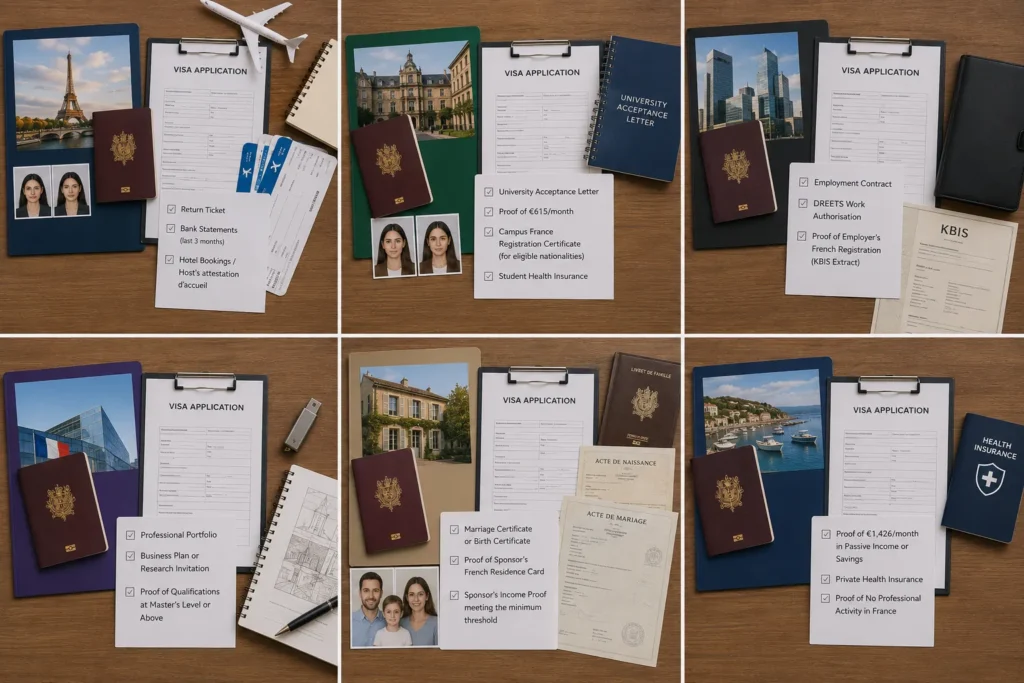
All France visa types require: a valid passport issued within the last 10 years, 2 passport-size photos (35mm × 45mm / 1.4 in × 1.8 in), the completed and signed CERFA form, proof of accommodation in France, and travel or health insurance with a minimum €30,000 coverage.
The additional documents per category are:
- Tourist / Private: return ticket, bank statements (last 3 months), hotel bookings or host’s attestation d’accueil
- Student: university acceptance letter, proof of €615/month, Campus France registration certificate (for eligible nationalities), and student health insurance
- Work / Salaried: employment contract, DREETS work authorisation, proof of employer’s French registration (KBIS extract)
- Talent Passport: professional portfolio, business plan or research invitation, proof of qualifications at Master’s level or above
- Family Long-Stay: marriage certificate or birth certificate, proof of sponsor’s French residence card, sponsor’s income proof meeting the minimum threshold
- Visitor (No Work): proof of €1,426/month in passive income or savings, private health insurance, proof of no professional activity in France
Which France Visa Type Is Right for You?
France visa types cover every purpose — from a 90-day tourist trip to a multi-year talent residency. Your correct visa depends on 3 factors: your nationality, the length of your stay, and the purpose of your visit. A short tourist trip needs a Type C Schengen visa at €80. A work contract lasting over 12 months needs a Type D Salarié visa with DREETS authorisation. A doctoral research placement needs a Talent Passport VLS-TS.
Getting the France visa type wrong delays your application, costs you non-refundable fees, and risks a refusal record that affects future Schengen applications.
Frequently Asked Questions

Michael Reynolds
Michael Reynolds leads immigration content at ImmigrationWin, covering visa requirements, application and relocation pathways. He researches immigration policies and official government guidance to explain changing rules clearly. His guides help students, families, and professionals make informed decisions about moving abroad.
Related Posts