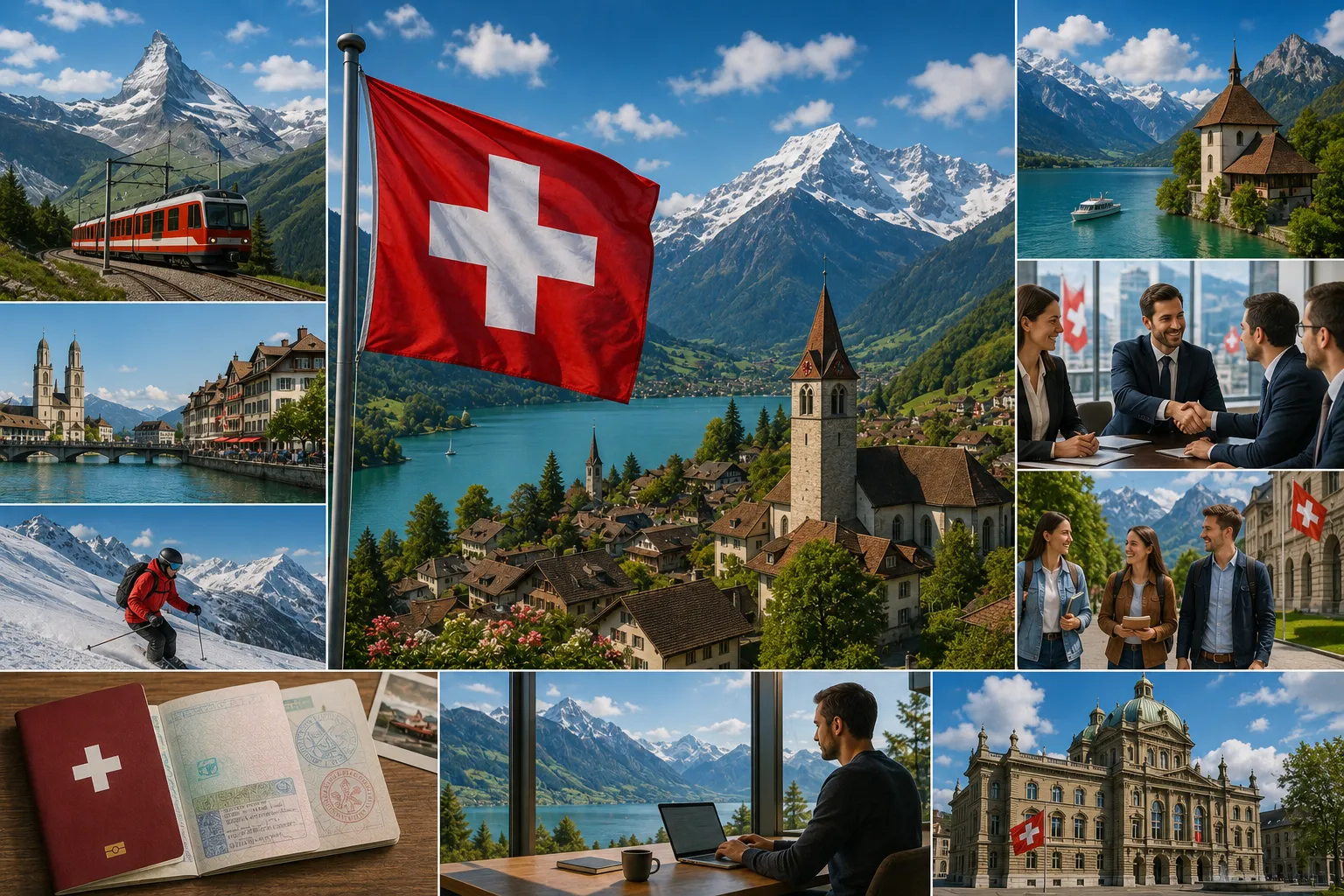
Switzerland Visa Types 2026: Complete Guide to All Categories
Switzerland offers 2 primary visa categories: the Schengen Type C visa for stays up to 90 days, and the national Type D visa for stays exceeding 90 days. Your nationality, the length of your stay, and your purpose of travel determine which of these Switzerland visa types applies to you.
Switzerland is a member of the Schengen Area but not of the European Union (EU). This distinction affects how you apply, what rights you receive, and which authorities process your application. The State Secretariat for Migration (SEM) oversees immigration at the federal level, while 26 cantonal migration offices handle most permit decisions locally.
What Are the Switzerland Visa Types in 2026?
Switzerland recognises 2 main visa categories for foreign nationals: the Schengen visa (Type C) and the national long-stay visa (Type D). Each serves a different purpose and duration.
Type C allows you to travel across all 29 Schengen member states for up to 90 days within any 180-day period. Type D is Switzerland-specific and authorises stays longer than 90 days for purposes such as work, study, family reunification, and retirement.
EU and European Free Trade Association (EFTA) nationals — citizens of Iceland, Liechtenstein, Norway, and Switzerland — do not require a visa to enter Switzerland. Non-EU/EFTA nationals from countries including India, China, Pakistan, and South Africa must apply before travel.
Switzerland Type C: Schengen Short-Stay Visa Explained
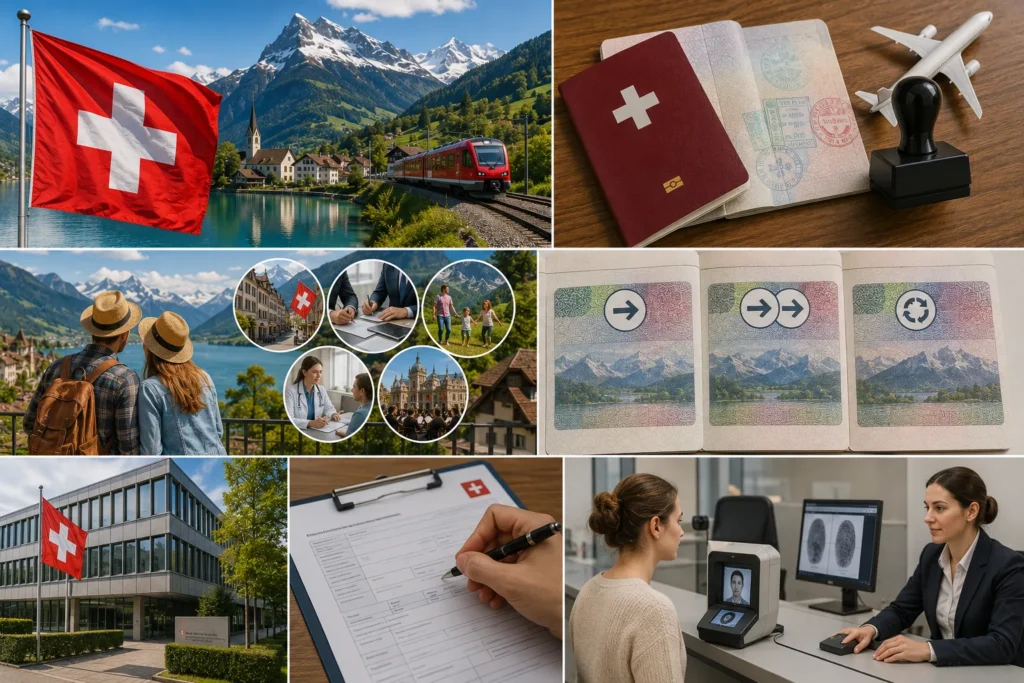
The Type C Schengen visa lets you stay in Switzerland and all other Schengen countries for a maximum of 90 days in any 180-day period. You can use this visa for tourism, short business visits, family stays, medical appointments, or cultural events.
Switzerland issues Type C visas in 3 entry formats: single-entry, double-entry, and multiple-entry. A single-entry visa allows 1 trip. A double-entry visa allows 2 separate trips. A multiple-entry visa lets you enter and exit the Schengen Area as often as needed within its validity period.
How to Apply for the Switzerland Schengen Visa
To apply for the Switzerland Schengen visa, submit your application to the Swiss embassy or consulate in your country of residence no earlier than 6 months before your planned travel date. You must apply in person, as biometric data collection — a facial photo and fingerprints — is mandatory.
Required documents include: a valid passport with at least 2 blank pages and validity extending 3 months beyond your departure date, a completed and signed visa application form, 1 recent biometric photograph, proof of return travel, hotel or accommodation booking, travel insurance covering a minimum of €30,000 in medical expenses, and proof of sufficient funds.
The standard processing time is up to 15 working days. Complex cases or peak travel periods extend processing to 45 calendar days. The visa fee is €90 for adults and €45 for children aged 6 to 11 years. Children under 6 travel free.
2025–2026 Update: EES and ETIAS for Schengen Travel
The Entry/Exit System (EES) began rolling out across Schengen countries including Switzerland from October 2025. EES replaces passport stamping. On your first entry, border officers collect your facial image and 4 fingerprints. The system then automatically tracks your 90-day usage.
The European Travel Information and Authorisation System (ETIAS) — a digital pre-travel authorisation — launches for visa-exempt nationals in late 2026. If your country currently qualifies for visa-free Schengen entry, you must obtain ETIAS approval before travelling.
Switzerland Type D: National Long-Stay Visa Categories
The Type D national visa authorises entry into Switzerland for stays exceeding 90 days. The Swiss embassy or consulate in your home country issues the visa after cantonal migration authorities approve your underlying residence permit application.
Processing time for Type D visas ranges from several weeks to 3 months, depending on the canton, visa category, and season. You must apply before arriving in Switzerland — you cannot convert a tourist entry into a long-stay visa from inside the country.
Switzerland offers 4 main Type D visa categories. These differ from Schengen visa types used across Europe. Each Swiss national visa links directly to a specific residence permit and purpose.
Switzerland Work Visa (Type D)
The Swiss work visa authorises you to enter Switzerland and begin employment with the sponsoring employer. Non-EU/EFTA nationals must receive a work permit from the cantonal migration authority before the visa is issued. The entire process takes 2 to 3 months.
Switzerland limits non-EU/EFTA work permits through annual quotas set by the Federal Council. For 2026, approximately 4,500 B permits and 4,000 L permits are available for non-EU/EFTA nationals nationally. Employers must demonstrate that no suitable Swiss or EU/EFTA candidate exists before sponsoring a non-EU/EFTA national.
Only qualified professionals qualify for Swiss work visas. Qualifications include a university degree, executive status, specialist skills in sectors such as information technology, healthcare, finance, and engineering, and several years of professional experience.
Switzerland Student Visa (Type D)
To obtain a Switzerland student visa, secure acceptance at a Swiss university, university of applied sciences, or accredited vocational school before applying. Institutions such as ETH Zurich (Eidgenössische Technische Hochschule) and the University of Geneva commonly sponsor student visa applicants.
Required documents include your acceptance letter, proof of tuition payment or scholarship, evidence of financial means to cover living costs in Switzerland (typically CHF 21,000 per year, approximately USD 23,000), and valid health insurance. The visa duration matches your course length.
Switzerland Family Reunification Visa (Type D)
The family reunification visa allows spouses, registered partners, and dependent children under 18 to join a Swiss citizen, permanent resident, or permit holder. Applicants must demonstrate A1-level language proficiency in the relevant Swiss language — German, French, or Italian — with exceptions for highly skilled professionals and minors.
The sponsoring family member in Switzerland must show adequate housing (a minimum of 10 square metres [108 sq ft] per person) and sufficient income to support all dependants without social assistance.
Switzerland Retirement Visa (Type D)
Retirees from non-EU/EFTA countries apply for the Switzerland retirement visa under the national Type D category for financially self-sufficient persons. You must prove sufficient passive income or savings to sustain yourself without working. Swiss authorities calculate required amounts by canton, but applicants typically demonstrate liquid assets of at least CHF 300,000 (approximately USD 330,000).
Retirement visa holders may not work in Switzerland. The initial permit is valid for 1 year and renews annually provided you continue to meet financial conditions.
Switzerland Visa Types for Workers: Understanding Residence Permits
A work visa gets you into Switzerland. The residence permit determines how long you can stay and what rights you hold while in the country. Switzerland issues 5 main permit types for workers: Permit L, Permit B, Permit C, Permit G, and Permit Ci.
Permit L (Short-Term Residence Permit) applies to employment contracts under 12 months. It ties you to your employer and cannot extend beyond 24 months total. Permit B (Initial Residence Permit) suits contracts exceeding 1 year. B permits are valid for 1 year for non-EU/EFTA nationals and 5 years for EU/EFTA nationals. Both are renewable.
Permit C (Settlement Permit) grants permanent residence rights. EU/EFTA nationals qualify after 5 years of continuous residence. Non-EU/EFTA nationals wait 10 years. Permit C holders change employers freely across all 26 cantons without further immigration approval.
Permit G (Cross-Border Commuter Permit) applies to EU/EFTA nationals who work in Switzerland but live in a neighbouring country — France, Germany, Italy, or Austria. Permit G holders must return to their home country at least once per week. Permit Ci (Intra-Company Transfer Permit) covers employees of multinational companies transferring to a Swiss office.
Switzerland Visa Types Quick-Reference Table
The table below summarises the 6 main Switzerland visa and permit types, their maximum permitted stay, primary purpose, and entry format.
| Visa Type | Max Stay | Purpose | Entry Type |
| Type C — Schengen | 90 days / 180-day period | Tourism, business, short study, family visits | Single, double, or multiple entry |
| Type D — National (Work) | 1+ years (tied to contract) | Employment, skilled worker roles | Single entry; work permit required |
| Type D — National (Study) | Duration of course | University or vocational education | Single entry; enrolment proof required |
| Type D — Family Reunification | 1 year (renewable) | Join Swiss citizen or permit holder | Single entry; A1 language level required |
| Type D — Retirement | 1 year (renewable) | Financial self-sufficiency, no work | Single entry; CHF proof required |
| Permit C — Settlement | Permanent (card renewed every 5 years) | Long-term residents after 5–10 years | No separate visa; resident right |
How to Choose the Correct Switzerland Visa Type for Your Situation
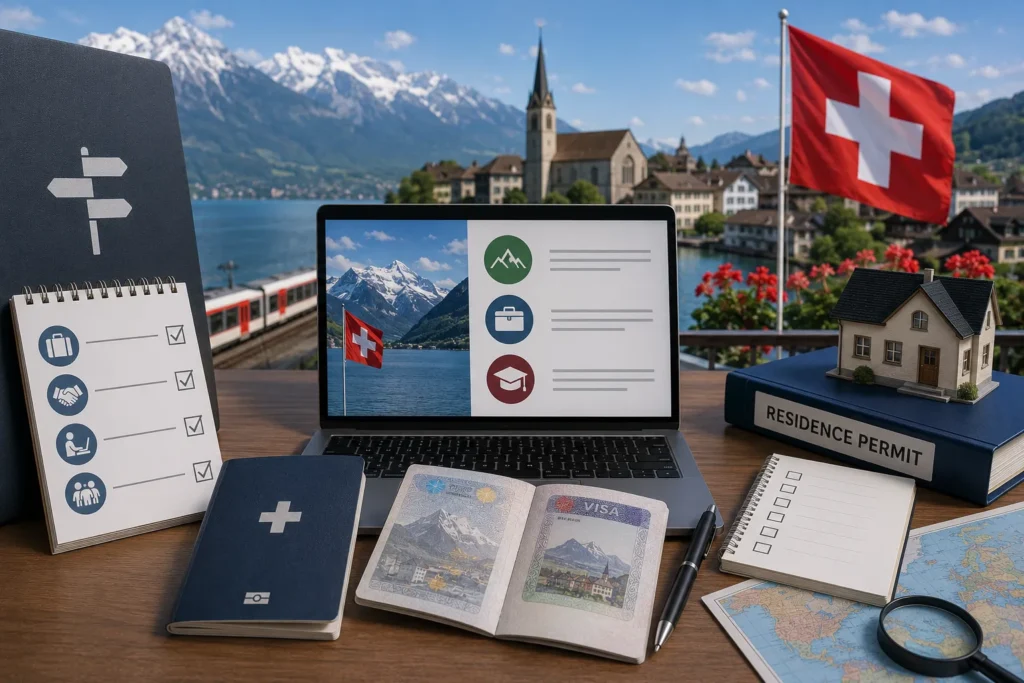
To choose the correct Switzerland visa type, match your purpose of travel and intended stay length to the categories above. Tourism or short business visits of under 90 days require a Type C Schengen visa. Any stay beyond 90 days requires a Type D national visa paired with the corresponding residence permit.
Non-EU/EFTA nationals face stricter qualification criteria. Employment requires a confirmed job offer from a Swiss employer who has already obtained cantonal work permit approval. You cannot search for work while inside Switzerland on a Type C visitor visa — you must leave and re-enter on the correct permit.
Switzerland’s permit system differs from other multi-entry destinations. For comparison, reviewing work visa options in countries like Australia shows how points-based systems approach skilled migration differently from Switzerland’s quota model.
EU/EFTA nationals benefit from the Agreement on Free Movement of Persons (AFMP). Citizens of EU member states and EFTA countries enter Switzerland without a visa, register with the local commune within 14 days of arrival, and apply directly to the cantonal migration authority for a residence permit tied to their employment contract.
How to Apply for a Switzerland Visa: 5-Step Process
To apply for a Switzerland visa, follow these 5 steps: determine the correct visa category, prepare all required documents, book an appointment at the Swiss embassy or consulate in your country of residence, attend the appointment in person and submit biometrics, then wait for processing.
Step 1: Determine Your Visa Category and Nationality Rules
Check whether your nationality requires a visa. Citizens of the USA, UK, Canada, Australia, and Japan enter Switzerland visa-free for up to 90 days. Citizens of India, Pakistan, China, and most African countries require a Type C Schengen visa for short stays. All non-EU/EFTA nationals require a Type D national visa for stays beyond 90 days.
Step 2: Prepare Supporting Documents
Prepare 3 core documents for every Switzerland visa application: a valid passport with at least 2 blank pages, a completed visa application form from the official Swiss government portal (swiss-visa.ch), and 1 colour biometric photograph no older than 6 months. Add purpose-specific documents — a job contract for work visas, an acceptance letter for student visas, or a sponsor declaration for family visas.
Applicants from countries in Asia may also find it useful to compare national visa requirements across multiple destinations. See the Japan visa guide for context on how Asian applicants navigate national visa categories.
Step 3: Submit at the Swiss Embassy
Submit your application at the Swiss embassy or consulate covering your place of residence — not simply the nearest Swiss embassy. You must apply in person for biometric data collection. The Schengen Visa Code specifies that you apply to the embassy of the country where you spend the most days if your trip covers multiple Schengen countries.
Step 4: Pay the Visa Fee
Pay the visa fee at submission. The Schengen Type C fee is €90 (approximately USD 100) for adults. The national Type D fee ranges from USD 47 to USD 94 depending on your nationality. Some nationalities pay reduced fees or receive fee waivers under bilateral agreements.
Step 5: Wait for Processing and Collect Your Visa
Standard Type C processing takes up to 15 working days. Type D national visa processing takes 4 to 12 weeks after the canton approves the underlying permit. From February 2024, Switzerland issues all visa types as both a digital barcode and a physical sticker on your passport — carry both for border presentation.
3 Common Mistakes to Avoid When Applying for Switzerland Visa Types
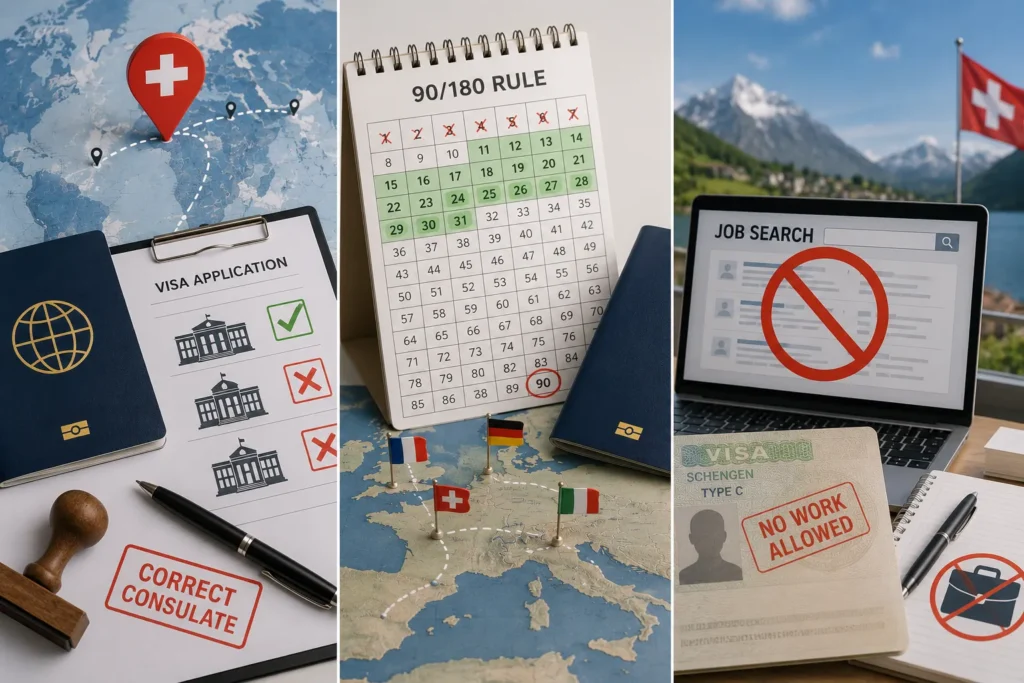
Applying to the wrong consulate: Apply at the consulate covering your country of residence, not just the nearest Swiss embassy. Applying to the wrong post delays or invalidates your application.
Ignoring the 90/180 rule: The 90-day limit applies to the entire Schengen Area, not just Switzerland. Days spent in France, Germany, Italy, or any other Schengen country count toward your Swiss allocation. Overstaying triggers bans and fines.
Starting a job search on a tourist visa: Non-EU/EFTA nationals cannot look for work while on a Type C visa inside Switzerland. Swiss law requires you to hold the approved work permit before entering for employment purposes.
Conclusion
Switzerland visa types divide clearly into 2 entry categories — Schengen Type C for short visits and national Type D for long-term residence — and 5 main work permit types (L, B, C, G, Ci) for those intending to work. Your nationality and purpose of travel narrow the correct path quickly.
Non-EU/EFTA applicants face quota restrictions, employer sponsorship requirements, and mandatory cantonal approval steps that add weeks to the timeline. Start your application at least 3 months before your intended arrival date. EU/EFTA nationals enjoy a simpler path under the Agreement on Free Movement of Persons.
Frequently Asked Questions

Michael Reynolds
Michael Reynolds leads immigration content at ImmigrationWin, covering visa requirements, application and relocation pathways. He researches immigration policies and official government guidance to explain changing rules clearly. His guides help students, families, and professionals make informed decisions about moving abroad.
Related Posts