New Green Card Rules 2026: What Every Applicant Must Know
The biggest green card rule change in decades happened on May 22, 2026. USCIS (U.S. Citizenship and Immigration Services) issued Policy Memorandum PM-602-0199, restricting Adjustment of Status (AOS) — the process that lets immigrants get a green card without leaving the US — to “extraordinary circumstances” only.
If you have a pending Form I-485, plan to file one, or hold a temporary visa and want permanent residence, these new green card rules directly affect your path forward. This guide covers exactly what changed, who is affected by visa category, what risks you face, and the 5 specific steps to take today.
What the New Green Card Rules Actually Changed in 2026
For decades, most immigrants in the US on temporary visas — H-1B workers, F-1 students, B-2 tourists, TN professionals — could file Form I-485 to apply for a green card without leaving the country. USCIS treated approval as routine once basic eligibility requirements were met.
On May 21, 2026, USCIS issued PM-602-0199, titled “Adjustment of Status is a Matter of Discretion and Administrative Grace, and an Extraordinary Relief.” The next day, USCIS announced publicly that AOS will be granted only in “extraordinary circumstances.”
Three things this memo does:
- Reclassifies AOS from a routine pathway into a discretionary, exceptional benefit.
- Makes consular processing the default — applicants must now leave the US and apply at a US embassy or consulate abroad.
- Applies retroactively — all pending I-485 applications face the new heightened standard, regardless of when they were filed.
One thing the memo does NOT do: it does not eliminate Form I-485. New I-485 applications are still accepted. But USCIS officers now apply strict discretionary review before approval — meeting eligibility requirements alone is no longer enough.
New Green Card Rules 2026: Before and After Comparison
This table shows exactly what changed across 8 key areas of green card policy.
| Category | Old Rule (Pre-May 2026) | New Rule (Post-May 2026) |
| Adjustment of Status (I-485) | Routine pathway — most eligible applicants approved | Discretionary only — ‘extraordinary circumstances’ required |
| Consular Processing | Optional alternative to AOS | Now the default route for most applicants |
| EAD Validity Period | Up to 24 months maximum | 18 months maximum (post-Oct 30, 2025 renewals) |
| Public Charge Test | Limited programs triggered public charge | Expanded scrutiny; 75-country visa pause in effect |
| H-1B / L-1 Dual-Intent | AOS broadly available | Still available but faces heightened discretionary review |
| F-1 Student AOS | Allowed with proper filing | Higher denial risk; single-intent visa scrutinized |
| Pending I-485 Cases | Approved under old standard at filing | Retroactively subject to new heightened standard |
| Background Checks | Standard identity verification | Expanded vetting: social media, criminal history, online presence |
Who the New Rules Affect — Broken Down by Visa Category
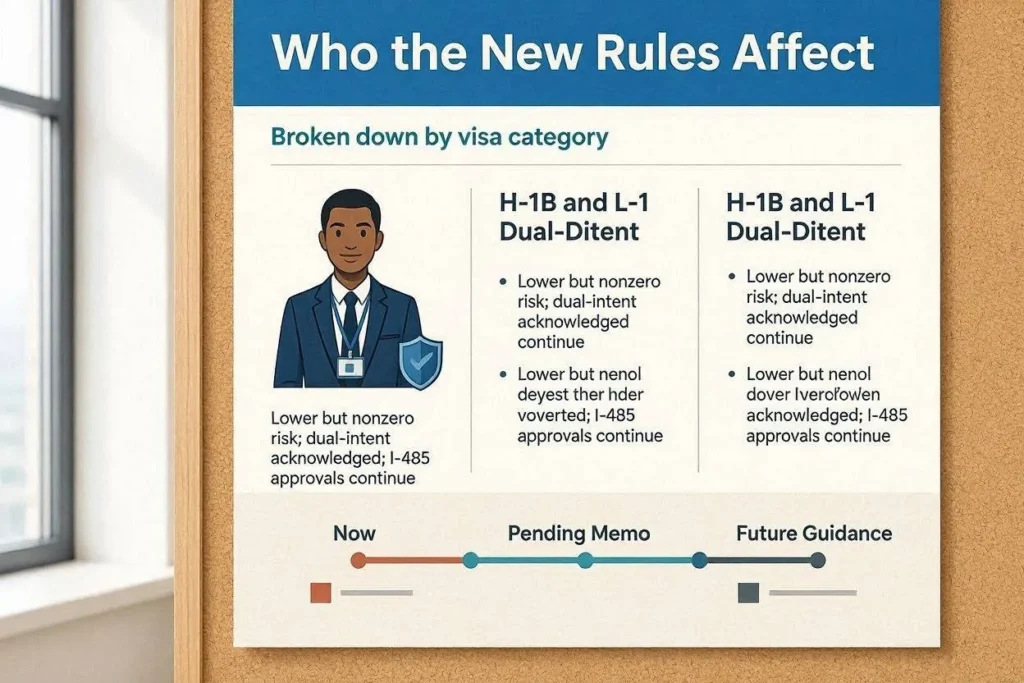
Impact varies significantly depending on your current visa status. Here is what each category faces.
H-1B and L-1 Dual-Intent Visa Holders
H-1B and L-1 holders face lower — but not zero — risk. The new USCIS memo acknowledges the dual-intent doctrine: H-1B and L-1 visa holders can legally hold both temporary work status and immigrant intent simultaneously.
USCIS officers will still approve I-485 applications from H-1B and L-1 holders who maintain lawful status and have a clean immigration history. However, maintaining lawful status alone no longer guarantees approval. Officers now weigh positive and negative discretionary factors, including employment history, past visa violations, and immigration compliance record.
H-4 spouses with EAD (Employment Authorization Document) cards face a related risk: EAD validity dropped from 24 months to 18 months for renewals filed after October 30, 2025. If the principal H-1B applicant’s I-485 is denied, the H-4 EAD is revoked at the same time.
F-1 Students and J-1 Exchange Visitors
F-1 and J-1 visa holders face significantly higher denial risk because both are single-intent visas. USCIS officers can now question why an F-1 student — who was admitted temporarily for education — chose to remain in the US rather than consular process abroad.
F-1 students with a clean compliance record and continuous lawful status carry a stronger case. F-1 students with OPT gaps, unauthorized employment, or prior status violations face serious denial risk under the new standard. STEM OPT extension holders should consult an immigration attorney before filing or continuing any pending I-485.
B-1/B-2 Tourist and Visitor Visa Holders
B-1 and B-2 visa holders face the highest scrutiny of any visa category. USCIS officers will weigh whether the applicant had immigrant intent at the time of admission — which conflicts directly with the purpose of a tourist visa. Marriage to a US citizen does not automatically solve this: officers will examine the timeline of the marriage and the visa entry.
TN, O-1, and E-2 Visa Holders
TN, O-1, and E-2 holders are all single-intent visa categories. These applicants face meaningful AOS denial risk and may be pushed toward consular processing — but leaving the US to consular process can trigger unlawful presence bars (see below) if the applicant accrued any unauthorized time.
The Unlawful Presence Trap: Why Leaving the US Can Be Dangerous
The new green card rules create a trap for thousands of applicants: if USCIS denies your I-485 and tells you to consular process, leaving the US may trigger a reentry bar.
Federal immigration law imposes 2 specific bars on immigrants who accumulated unlawful presence:
- More than 180 days but less than 1 year of unlawful presence triggers a 3-year bar from re-entering the US.
- 1 year or more of unlawful presence triggers a 10-year bar from re-entering the US.
An applicant who overstayed a visa while waiting for an I-485 decision may have accumulated unlawful presence without realizing it. Departing the US to complete consular processing in that situation makes re-entry impossible, even with an approved immigrant petition.
Do not leave the US based on an AOS denial before consulting an immigration attorney. A departure that looks simple can block your return for 3 to 10 years.
4 Other Green Card Policy Changes in 2026 You Must Know

1. Public Charge Rule Tightening
In late 2025, the Trump administration proposed rescinding the 2022 public charge rule. The proposal is not yet final — the 2022 rule remains current law. Under the 2022 rule, only applicants likely to become primarily dependent on cash assistance for income maintenance face public charge denial.
Separately, the Department of State (DOS) paused immigrant visa processing for nationals of 75 countries starting January 21, 2026, based on public charge concerns. This ban applies to consular processing — not to in-country I-485 filings. Countries affected include nations across Africa, Asia, and the Middle East.
2. EAD Validity Shortened to 18 Months
EAD (Employment Authorization Document) validity dropped from 24 months to 18 months maximum for most categories. Renewals filed on or after October 30, 2025 no longer receive the automatic 540-day extension that previously protected workers during processing delays. File EAD renewals at least 6 months before expiration to maintain continuous work authorization.
3. SBA Loan Ban for Green Card Holders
Starting March 1, 2026, the US Small Business Administration (SBA) banned green card holders from SBA-backed small business loans. The new rule requires that 100% of all direct and indirect business owners must be US citizens to qualify for SBA loan programs. Green card holders who previously qualified are no longer eligible.
4. Expanded Background Checks and Social Media Vetting
USCIS and DOS expanded background vetting protocols across all case types. H-1B and H-4 applicants must now disclose all social media user IDs and maintain public access to those accounts during adjudication. Enhanced identity verification and criminal history checks apply to standard green card adjudications. USCIS also reserved authority to conduct retrospective review of approved cases going back 4 to 5 years when applicants file for future benefits including naturalization.
What to Do If You Have a Pending I-485 Application
Do not withdraw your pending I-485 application without attorney guidance. The memo contains no grandfathering provision, meaning your case is subject to the new heightened standard at the time of final adjudication — but withdrawal eliminates options that may still be available to you.
Take these 5 steps immediately if you have a pending I-485:
- Consult an immigration attorney today. The impact of PM-602-0199 depends on your visa category, immigration history, and case timeline. Get a case-specific assessment — not general advice.
- Maintain lawful status continuously. Status violations after May 22, 2026 are now major negative discretionary factors. Keep your visa current.
- Document positive discretionary factors. Employment history, US family ties, community contributions, tax compliance, and length of residence all strengthen your case for AOS.
- Do not travel outside the US without reviewing your unlawful presence exposure and understanding what your advance parole status means under the new policy.
- Respond to RFEs quickly and thoroughly. Expect increased Requests for Evidence (RFEs) asking why you should be allowed to adjust status in the US rather than consular process abroad.
Is Consular Processing Now the Safer Route in 2026?

Consular processing is now the US government’s preferred route for most applicants. But consular processing is not automatically safer — especially for applicants with any unlawful presence history or from one of the 75 countries currently under the visa pause.
Consular processing makes sense if you:
- Hold a clean immigration record with no unlawful presence
- Are from a country not affected by the 75-country visa pause or 39-country travel ban
- Have a current priority date and an approved I-140 petition
- Are outside the US or willing and able to leave without triggering a bar
Consular processing carries serious risk if you:
- Accumulated any unlawful presence — departure triggers the 3-year or 10-year bar
- Are from one of the 75 paused countries — immigrant visa issuance is suspended at consulates for nationals of these countries
- Have prior immigration violations, denied visas, or removal orders in your history
Conclusion
The new green card rules took effect May 22, 2026 and apply to every pending and future I-485 application. USCIS now treats adjustment of status as discretionary relief — not an automatic step — and has made consular processing the default route for most applicants. Unlawful presence traps, retroactive application to pending cases, expanded vetting, and the 75-country visa pause make this the most complex green card landscape in decades.
The immigrants who protect their cases successfully share one trait: they get legal guidance before making any move. Do not withdraw a pending I-485. Do not leave the US. Do not miss an RFE deadline.
The team at ImmigrationWin.com stays current with every USCIS policy change so you get accurate, actionable guidance for your specific case. Contact us today for a consultation before the new rules complicate your path to permanent residence.
Frequently Asked Questions

Michael Reynolds
Michael Reynolds leads ImmigrationWin’s immigration, visa, and global mobility content division. He specializes in researching immigration policies, visa requirements, application processes, and international relocation pathways for individuals, families, students, and professionals. With extensive experience analyzing immigration regulations and official government guidance, Michael brings a research-driven approach to complex immigration topics and changing visa policies. He is the primary author of ImmigrationWin’s visa guides, immigration resources, and country-specific content, helping readers better understand their options and make informed decisions about their international journey.
Related Posts